
Concrete vs. Vinyl vs. Steel Seawalls: Which Lasts?
Comparing concrete, vinyl, and steel seawall materials for South Florida waterfront properties — longevity, maintenance, cost, and performance in saltwater and hurricane conditions.
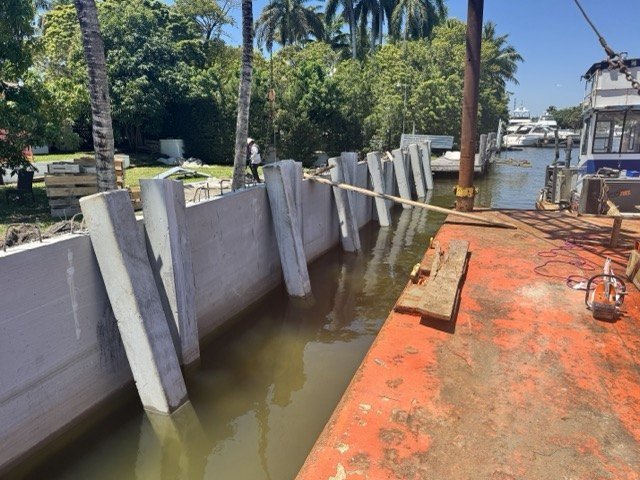
Choosing a seawall material is one of the most consequential structural decisions a South Florida waterfront property owner will make. Get it right and you have a wall that protects your property through decades of tidal cycles, storm surges, and saltwater exposure. Get it wrong and you face expensive repairs — or full replacement — well before the end of an expected service life.
The three materials dominating new construction and replacement projects in Miami-Dade, Broward, and Palm Beach are concrete (precast or cast-in-place), vinyl sheet pile, and steel sheet pile. Each has a defined range of applications where it performs well — and conditions where it struggles. This guide walks through the engineering and practical differences so you can ask better questions before any contractor puts a proposal in front of you.
Key takeaways
- Concrete is the dominant choice for South Florida marine environments — it resists saltwater corrosion, is code-compliant in HVHZ conditions, and provides the best long-term value for most residential and commercial applications.
- Vinyl sheet pile has a legitimate role in low-impact residential settings and bulkhead applications where load demands are modest — but it is not appropriate for heavy surge exposure or properties requiring engineer-sealed structural reports for permitting.
- Steel sheet pile is primarily a commercial and industrial material in Florida — it corrodes rapidly in saltwater without aggressive protection systems and is rarely the right choice for residential waterfront applications.
- Material selection always follows a structural engineering assessment — the right material depends on soil conditions, loading environment, tidal exposure, and regulatory requirements at the specific site, not generic cost comparisons.
- In South Florida’s High Velocity Hurricane Zone, all permanent seawall structures must comply with HVHZ provisions of the Florida Building Code — a factor that rules out some material options regardless of cost preference.
Why material selection matters more in South Florida than most coastal markets
South Florida’s marine environment is among the most aggressive in North America for structural materials. The combination of saltwater, high chloride concentration, continuous tidal loading, tropical storm exposure, and year-round high humidity creates conditions that expose material weaknesses faster than temperate coastal markets.
Miami-Dade and Broward counties are designated High Velocity Hurricane Zone (HVHZ) jurisdictions. This designation imposes stricter structural requirements on all permanent construction — including seawall systems — than the standard Florida Building Code provisions that apply elsewhere in the state. Any material choice that cannot meet HVHZ structural requirements is not eligible for permitted permanent installation in those counties.
The practical implication: material decisions made on cost alone, without accounting for code compliance, service life in high-chloride exposure, and structural adequacy under hurricane-condition loading, often result in shorter-than-expected service life and re-permitting costs that erase any initial savings.
Concrete seawalls
Construction types
Concrete seawalls in South Florida are built in two primary configurations. Precast concrete sheet pile — the most common — uses factory-manufactured concrete panels driven or placed in a continuous line, with cast-in-place concrete cap and tieback anchors. Cast-in-place systems are built on-site using forms; they are more common in commercial applications or where site constraints make precast panel delivery difficult.
Modern precast panels manufactured for South Florida use are typically produced under controlled plant conditions with high-strength concrete mixes (typically 5,000 to 6,000 PSI), low water-cement ratios, and increased cover depths over reinforcing steel — all designed to extend service life in high-chloride exposure categories per ACI 318 and the Florida Building Code durability provisions.
Performance in South Florida conditions
Properly specified and installed concrete is the most durable long-term choice for South Florida waterfront structures. The material’s primary weaknesses — rebar corrosion and spalling — are manageable through concrete quality, cover depth, and supplemental protection measures. Concrete is not affected by UV degradation, does not creep under sustained load the way some polymer materials do, and its structural performance characteristics (flexural strength, modulus of elasticity) are predictable and well-established under the load conditions South Florida seawalls experience.
Concrete is fully compliant with HVHZ requirements when properly specified. Engineer-sealed structural drawings for concrete seawall systems are accepted by Miami-Dade and Broward building departments and by FDEP and Miami-Dade DERM for submerged lands authorization.
Limitations and failure modes
Rebar corrosion is the primary failure mode in aging concrete seawalls. In South Florida’s chloride-rich environment, concrete manufactured before current durability code provisions — lower water-cement ratios, higher cover depths, supplemental corrosion inhibitors — shows earlier onset of rebar corrosion than panels built to current standards. Once corrosion begins, it is self-accelerating: the rust byproduct expands, cracks the cover concrete, exposes more rebar to chloride penetration, and corrosion rate increases.
Concrete walls also require maintained tieback systems. If tieback rods or anchor hardware corrodes and loses capacity, the wall begins to rotate outward under soil pressure — a failure mode that begins visibly as panel lean and progresses to structural failure if not addressed. A professional seawall inspection evaluates tieback condition alongside panel condition as part of every full assessment.
Expected service life
Concrete seawalls built to current Florida Building Code durability standards have design service lives in the range of 40 to 60 years with routine maintenance — including joint resealing, periodic cap and panel crack repair, and tieback inspection. Older walls built before current durability standards (pre-1990s construction) typically show active deterioration in the 25–40 year range and should receive professional engineering assessment to determine remaining service life and repair scope.
Typical cost range
New concrete seawall construction in South Florida ranges from approximately $400 to $700 per linear foot for standard residential applications, depending on wall height, site access, soil conditions, and the complexity of permitting. Concrete seawall repair — tieback augmentation, panel crack repair, joint resealing, cap reconstruction — typically ranges from $150 to $350 per linear foot depending on scope. Full replacement of an existing concrete wall runs $500 to $900 or more per linear foot when permit costs, FDEP authorization, and contractor margin are included.
Vinyl sheet pile seawalls
Construction type
Vinyl sheet pile seawalls use interlocking panels extruded from high-density polyvinyl chloride (PVC) or composite polymer formulations, driven continuously along the seawall line. Vinyl systems are commonly used in lower-load residential bulkhead applications — canal-facing residential lots, lake edges, and low-energy shorelines where wave action and tidal surge are minimal.
Performance in South Florida conditions
Vinyl has one genuine advantage in saltwater environments: it does not corrode. There is no rebar inside a vinyl sheet pile to rust. The material itself is chemically inert to the chloride concentrations found in South Florida coastal soils and seawater. For low-energy residential applications — calm-water canals, protected coves — vinyl can provide 20 to 40 years of service life with minimal maintenance.
Vinyl is also lighter than concrete or steel, which reduces installation equipment requirements and can lower installation cost in accessible locations. This makes it an attractive entry-point option for lower-budget residential replacements.
Limitations and failure modes
Vinyl’s structural limitations are significant in South Florida’s full exposure conditions. The material has lower flexural strength and stiffness than concrete or steel — under the sustained lateral earth pressure loads and cyclical tidal loading that South Florida seawalls experience, vinyl panels can creep, deflect, or pull apart at interlocking joints over time. In high-surge conditions — any site that experiences meaningful wave action or hurricane surge — vinyl sheet pile is generally not adequate as a primary structural seawall.
UV degradation is a real factor in Florida’s high-UV environment. Exposed vinyl above the waterline degrades with prolonged UV exposure, becoming brittle over time. Quality products use UV-stabilized formulations, but the material’s long-term UV resistance in Florida conditions is an open question compared to concrete’s track record.
Most critically for South Florida: vinyl sheet pile is generally not accepted for HVHZ compliance under current Florida Building Code structural requirements for permanent seawalls in Miami-Dade and Broward counties. Permits for vinyl seawall systems in these jurisdictions face higher scrutiny, and engineer-sealed drawings may be required to demonstrate adequacy — a process that, for a material at the edge of structural adequacy, often results in a recommendation for concrete instead.
Expected service life
In appropriate low-energy applications, vinyl seawalls deliver 20 to 40 years of service life. In high-exposure conditions — ocean-adjacent, exposed bay frontage, properties subject to storm surge — service life is substantially shorter and structural failure risk is higher.
Typical cost range
Vinyl sheet pile installation in South Florida typically ranges from $150 to $350 per linear foot depending on wall height, product grade, and site access. The lower upfront cost relative to concrete is the primary driver for vinyl selection in residential applications — but the shorter service life and potential for earlier-than-expected replacement must be factored into the true cost comparison.
Steel sheet pile seawalls
Construction type
Steel sheet pile seawalls use cold-formed interlocking steel sections — typically Z-pile or U-pile profiles — driven continuously to form a continuous retaining wall. Steel sheet pile is common in commercial marine construction: docks, port facilities, marina bulkheads, industrial waterfront applications where high structural capacity and rapid installation are priorities.
Performance in South Florida conditions
Steel provides high structural capacity — it can be designed to resist the substantial lateral earth pressure loads found in deep-water or high-surcharge applications where concrete panel systems may be less economical. For commercial-scale applications where the budget includes aggressive corrosion protection, steel can be a viable option.
Limitations and failure modes
Steel’s fundamental limitation in South Florida is corrosion. Unprotected steel in a saltwater splash zone deteriorates rapidly — corrosion rates in South Florida’s marine environment can reduce steel section thickness measurably within five to ten years without protective coatings, cathodic protection systems, or sacrificial anodes. Once section loss exceeds design tolerances, structural capacity is compromised.
Maintaining corrosion protection on a steel seawall is an ongoing operational cost. Epoxy coatings and coal tar epoxy systems require periodic reapplication. Cathodic protection systems require monitoring and anode replacement. The total cost of ownership for a properly maintained steel seawall in South Florida — capital cost plus ongoing protection maintenance — typically exceeds concrete for equivalent structural performance.
For residential applications, steel sheet pile is rarely the right choice. The corrosion management burden, the need for specialty maintenance, and the availability of concrete systems that provide equivalent structural performance with lower maintenance requirements make concrete the more practical solution for South Florida residential waterfront structures.
Expected service life
With aggressive corrosion protection — hot-dip galvanizing, multi-coat epoxy systems, cathodic protection, and regular inspection — steel seawalls can achieve 30 to 50 year service lives in marine environments. Without maintained protection, significant section loss typically appears within 10 to 20 years in South Florida saltwater conditions.
Typical cost range
Steel sheet pile installation in South Florida ranges from $300 to $600 or more per linear foot for materials and installation in commercial applications. When corrosion protection systems and ongoing maintenance costs are included in a lifecycle cost analysis, steel rarely shows a cost advantage over concrete for residential or standard commercial seawall applications.
Direct comparison: which material is right for your property?
No single answer applies to every South Florida waterfront property. The right material depends on the specific loading conditions, tidal exposure, soil type, regulatory environment, and budget of each site. That said, a few consistent patterns emerge from engineering practice across the region:
For most residential and commercial properties in Miami-Dade, Broward, and Palm Beach — canal-facing, bay-adjacent, or Intracoastal frontage — concrete sheet pile is the baseline recommendation. It provides the best combination of structural adequacy, HVHZ code compliance, long-term corrosion resistance, and service life for the range of loading conditions these properties experience.
Vinyl sheet pile has a defined role in low-energy residential bulkhead applications — calm-water canals with minimal surge exposure — where the reduced structural demands align with the material’s capacity and where the lower initial cost is a meaningful factor. It is not appropriate for exposed bay frontage, oceanfront applications, or any site in HVHZ jurisdictions where code compliance requires demonstrated structural adequacy.
Steel sheet pile is primarily appropriate for commercial and industrial applications where high structural capacity is required and where the corrosion protection budget and maintenance commitment are in place. For standard residential seawall replacement in South Florida, steel is rarely the first choice.
What a structural engineering assessment tells you
A material selection comparison is a useful starting point — but the actual decision for any specific property requires a structural engineering assessment. Soil conditions at your site affect how panels perform under lateral earth pressure. The height of the retained soil and the tidal range determine the design loads the wall must resist. Nearby structures — dock pilings, slabs, buildings — add surcharge loads that affect required panel section size and tieback capacity.
A Florida-licensed structural engineer assesses these site-specific factors and specifies the appropriate material, panel section, tieback configuration, and cap design for your property’s conditions. That specification then drives the permit drawings submitted to the building department, FDEP, and DERM — and it provides the engineering basis contractors must follow during installation.
At Souffront Contractors, every new seawall or replacement project begins with an engineering-led condition assessment — whether we are evaluating an existing wall for repair or developing specifications for new construction. The assessment drives the specification; the specification drives the design; the design drives the permit. This sequence is what produces a wall that performs as designed for its full service life.
How Souffront handles seawall construction and replacement in South Florida
Souffront Contractors provides engineer-led seawall assessment, design, permitting, and construction across Miami-Dade, Broward, and Palm Beach counties. When an existing wall has reached the end of its service life, we assess the site conditions, specify the appropriate replacement material and system, develop the structural drawings, manage the permitting process through FDEP, DERM, and the local building department, and execute the replacement under a single contract.
We do not sell materials — we recommend what is appropriate for each site based on the engineering. For most South Florida residential and commercial replacement projects, that recommendation is concrete. When site conditions or budget constraints make another material appropriate, we specify accordingly and document the engineering basis in the design drawings.
Our service area covers waterfront properties throughout Miami, Miami Beach, Fort Lauderdale, Boca Raton, and across the tri-county region.
Talk to a Florida-licensed engineer before you choose a material
If you are planning a seawall replacement or have received contractor proposals recommending different materials, contact Souffront Contractors at (877) 420-7220 before committing. We can review your site conditions, explain the engineering rationale behind a material recommendation, and give you an independent engineering perspective on what is appropriate for your property. Most inquiries receive a same-business-day response.
Frequently asked questions
What is the best seawall material for South Florida?
For most South Florida waterfront properties — residential and commercial — precast concrete sheet pile is the best-performing long-term choice. It provides the highest resistance to saltwater corrosion relative to its structural capacity, meets HVHZ code requirements in Miami-Dade and Broward, and delivers the longest service life for most loading conditions. Vinyl has a role in low-energy residential canal applications. Steel is primarily a commercial and industrial material in Florida’s saltwater environment.
How long does a concrete seawall last in Florida?
Concrete seawalls built to current Florida Building Code durability standards — high-strength concrete, adequate cover depth over rebar, proper tieback hardware specification — have design service lives of 40 to 60 years with routine maintenance. Walls built before current standards (pre-1990s) typically begin showing deterioration requiring professional assessment in the 25–40 year range. Service life varies significantly based on construction quality, site exposure, and maintenance history.
Is vinyl sheet pile a good choice for a South Florida seawall?
Vinyl sheet pile is appropriate in specific low-energy residential applications — calm-water canal lots with minimal wave action or storm surge exposure and modest structural demands. It is not appropriate for exposed bay or ocean frontage, properties in HVHZ jurisdictions where code compliance requires demonstrated structural adequacy, or any application where the loading conditions exceed vinyl’s structural capacity. If a contractor is recommending vinyl for an exposed South Florida waterfront property, ask for a licensed structural engineer to review the recommendation before proceeding.
Why is steel sheet pile uncommon for residential seawalls in South Florida?
Steel corrodes rapidly in South Florida’s saltwater environment without aggressive and consistently maintained protection systems. The ongoing cost of maintaining epoxy coatings, cathodic protection systems, and inspection programs makes steel’s total lifecycle cost higher than concrete for equivalent structural performance in residential applications. Steel is more appropriate where its structural capacity advantages are needed — commercial and industrial marine construction — and where the operational budget for corrosion management exists.
Does seawall material selection affect permit approval in Miami-Dade?
Yes. Miami-Dade and Broward counties are High Velocity Hurricane Zone (HVHZ) jurisdictions. Permanent seawall structures in these counties must demonstrate compliance with HVHZ structural provisions of the Florida Building Code. Not all materials meet these requirements. Vinyl sheet pile faces higher scrutiny in HVHZ jurisdictions, and permits for vinyl systems may require additional engineering documentation to demonstrate structural adequacy. Concrete systems designed and sealed by a Florida-licensed structural engineer are the standard basis for HVHZ-compliant seawall permits in Miami-Dade and Broward.
How much does seawall replacement cost in South Florida?
Seawall replacement in South Florida ranges from approximately $400 to $900 or more per linear foot depending on material, wall height, site access, soil conditions, and permitting complexity. Concrete replacement typically falls in the $500 to $900 range all-in. Vinyl installation is generally lower at $150 to $350 per linear foot. However, initial installation cost is only one component — service life, maintenance requirements, and the cost of potential early replacement should all factor into the total cost comparison. A licensed structural engineer can help you evaluate true lifecycle cost for your specific site.
Can I mix seawall materials during a repair or partial replacement?
In limited circumstances, yes — but it requires careful engineering review. Inserting vinyl panels into an existing concrete wall, for example, creates differential stiffness at the transition points that may cause stress concentrations under load. Any partial replacement or material mixing scenario should be reviewed by a Florida-licensed structural engineer who can assess whether the combination is structurally adequate and how the transition details should be designed and constructed.
Does seawall material affect property value in South Florida?
Seawall condition and material quality are increasingly scrutinized in South Florida real estate transactions. Buyers, lenders, and title companies for waterfront properties frequently require seawall condition assessments. A concrete wall in good condition with an engineer-sealed inspection report supports a clean transaction. A vinyl wall at the end of its service life, or a steel wall with visible corrosion damage, may trigger repair requirements or price adjustments. Properties with documented seawall deficiencies routinely trade at discounts relative to comparable waterfront properties with structurally sound walls.
About Souffront Contractors Inc.: a Florida-licensed structural engineering and marine construction firm serving Miami-Dade, Broward, and Palm Beach counties. Learn more about engineer-led seawall repair across South Florida — or call (877) 420-7220.
Got a seawall or structural question?
Five fields. Same business day from a Florida-licensed engineer, routed into our dispatch CRM in real time.
- Same business dayAcknowledgment from a Florida licensed engineer — Mon–Fri 8 AM–5:30 PM.
- Engineer-sealed reportAccepted by carriers, building departments, and real-estate transactions.
- Fixed-fee proposalNo hourly billing. Repair scope priced line-by-line.