
King Pile & Batter Pile: How They Support a Seawall
How king piles and batter piles hold up a seawall, why angle matters, and the warning signs of pile failure. A Florida-licensed engineer explains.
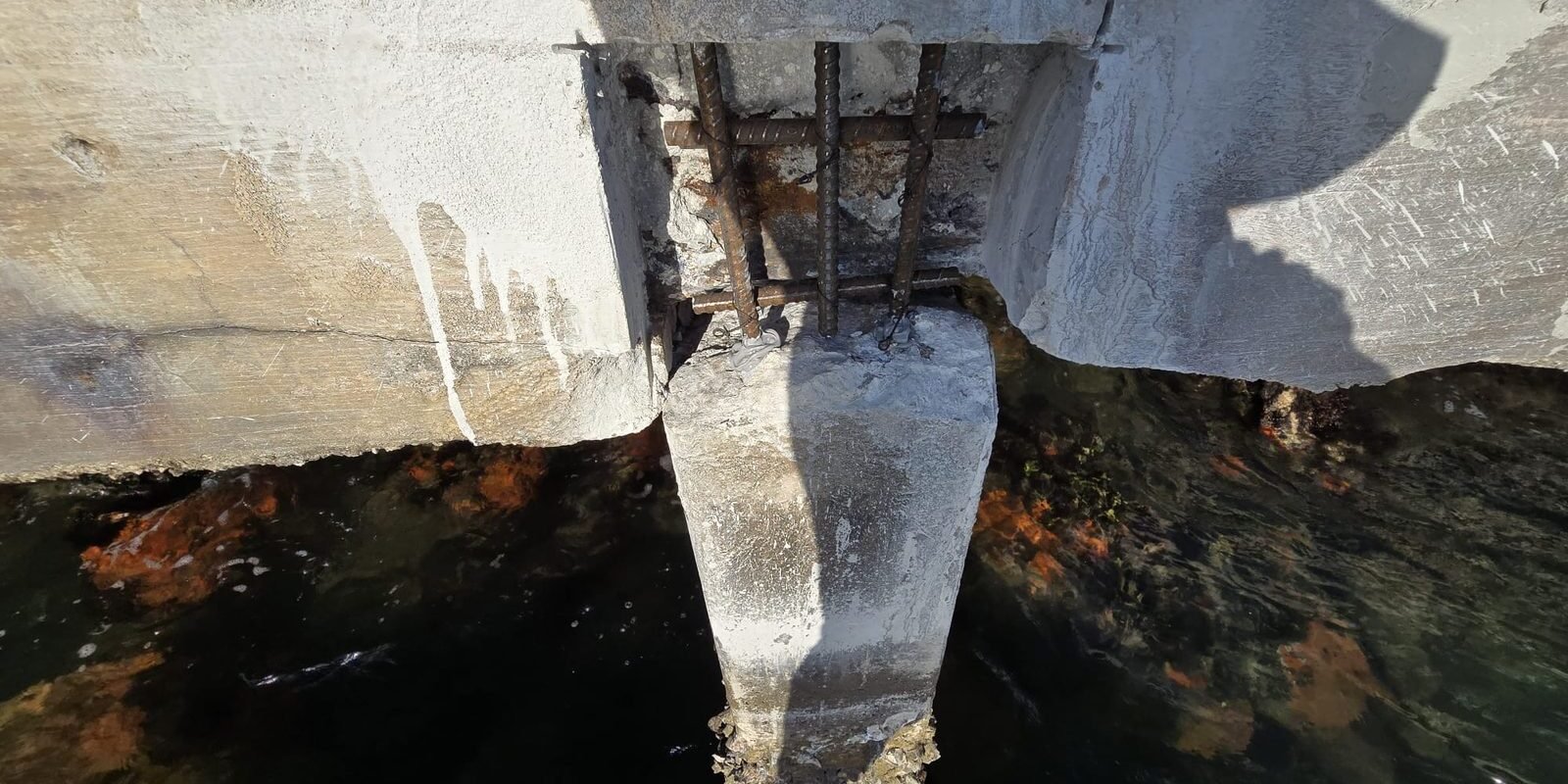
A king pile and a batter pile support a seawall in two different ways: the king pile carries vertical load straight down into the ground, while the batter pile is driven at an angle so it resists the horizontal push of soil and water behind the wall. Together they form the structural backbone of a pile-supported seawall, holding the wall face upright against constant lateral pressure. Understanding how each pile works helps waterfront owners recognize what “good,” “fair,” and “failing” actually mean on an inspection report.
Key takeaways
- King piles are vertical piles that carry the wall’s dead load and help anchor the cap and panel system.
- Batter piles are driven at an angle (commonly 1:3 to 1:6) specifically to resist horizontal soil and hydrostatic pressure.
- Not every seawall has king or batter piles — cast-in-place concrete bulkheads rely on buried tiebacks instead.
- Rust staining, cap cracking, or a wall leaning waterward can indicate pile or connection failure below the waterline.
- Because most pile damage is underwater, it is usually only confirmed through a diver-assisted structural inspection.
What is a king pile?
A king pile is a vertical structural pile, usually concrete, steel, or timber, driven into the ground at regular intervals along a seawall. In a pile-supported wall system, king piles are typically the larger, more heavily reinforced piles in the row — they carry more of the vertical load from the cap, walkway, or any structure built above the wall, and they often anchor the horizontal cap beam that ties the whole system together.
Because king piles run straight down, they are efficient at resisting vertical (compressive) load but limited in resisting horizontal force on their own. That is where the batter pile comes in.
What is a batter pile?
Batter pile — a pile driven at an angle rather than straight down, so that its length runs diagonally from the seawall face back into the soil behind it. The angle lets the pile resist horizontal force through simple axial compression or tension, instead of relying on the pile bending sideways, which is a much weaker way to resist load.
Seawalls constantly push against horizontal force: the weight of retained soil, groundwater pressure, and wave or boat wake action all load the wall face outward, toward the water. A vertical pile resists that push poorly — it has to flex. A batter pile resists it well, because the angled pile is doing what piles do best: carrying load along its own length.
How king piles and batter piles work together
In a typical pile-supported seawall, king piles and batter piles are installed as a paired system, often in a repeating pattern along the length of the wall:
- King piles carry vertical load and tie into the cap beam and panel system.
- Batter piles are installed at an angle behind or alongside the king piles to resist the horizontal thrust of retained soil.
- The cap beam ties both pile types together at the top, distributing load evenly instead of concentrating it on any single pile.
- Sheet piling or precast panels form the wall face between the piles, holding back soil but relying on the king and batter piles for the structural work.
When this system is properly engineered and installed, the batter piles do most of the work of keeping the wall from leaning or sliding toward the water, while the king piles keep the structure from settling vertically. A wall that is leaning, bulging, or rotating at the top is usually telling you that one of these load paths has weakened — most often the batter pile connection or the soil anchoring it.
Not every seawall has king and batter piles
Wall type matters here. South Florida has two common seawall systems, and they support horizontal load in different ways:
- Pile-supported seawalls use king piles and batter piles as described above, with a cap beam and face panels spanning between them.
- Cast-in-place concrete bulkheads do not use king or batter piles at all. Instead, they rely on buried tieback rods (sometimes called deadman anchors) that run from the wall back into the yard and connect to a buried anchor block or plate.
Both systems accomplish the same goal — resisting the horizontal push of retained soil — through different structural means. A wall’s age, construction records, or visible cap detailing usually tell an engineer which system is present before any diving inspection begins.
Signs of king pile or batter pile distress
Because most piles sit below the waterline, direct visual confirmation usually requires an underwater component to the inspection. Above the waterline, these signs often point to pile or connection problems below:
- The wall cap or panels leaning or rotating toward the water
- Cracking or spalling concentrated near pile locations along the cap
- Rust staining bleeding through the cap or panel face, indicating corroding reinforcing steel
- Visible gaps or voids at the base of the wall, suggesting soil loss around a weakened pile
- A wall that has shifted out of alignment compared to older surveys or photos
Any of these findings warrants a closer structural seawall inspection, including a below-waterline review where conditions allow, to confirm whether the king piles, batter piles, or their connections have deteriorated.
Why pile type affects repair strategy
Knowing whether a wall relies on king and batter piles or on tiebacks changes how a repair is engineered. A wall with a failing batter pile connection may need supplemental batter piles or bracket repairs at the existing pile heads. A cast-in-place bulkhead with a failed tieback needs the anchor system replaced or reinforced, not new piles. General South Florida seawall repair costs typically run $100–$250 per linear foot for moderate repairs, with full panel and pile or tieback replacement running roughly $400–$600 per linear foot — these are general industry ranges, and the right scope only comes from a documented inspection, not a guess from the seawall’s visible condition alone.
This is also where seawall construction and repair and engineer-sealed reporting intersect: the report identifies which piles or anchors are compromised, and the repair scope follows directly from that finding rather than a general assumption about the wall’s age.
Talk to a Florida-licensed engineer
If your seawall is leaning, cracking near the cap, or showing rust staining, the fastest way to know what is happening below the waterline is a structural inspection from a Florida-licensed engineer, not a repair estimate from a contractor guessing at the cause. Souffront Contractors inspects, engineers, permits, and builds as one company, with every inspection quoted as a flat fee before any site visit and every finding delivered in an engineer-sealed report. Reach us at (877) 420-7220, or use the form below to schedule.
Frequently asked questions
What is the difference between a king pile and a batter pile?
A king pile is driven vertically and primarily carries vertical load from the cap and any structure above the wall. A batter pile is driven at an angle specifically to resist the horizontal push of soil and water behind the seawall. Most pile-supported seawalls use both together.
Do all seawalls have king piles and batter piles?
No. Pile-supported seawalls use king and batter piles with a cap beam and panel system. Cast-in-place concrete bulkheads use a different anchoring system — buried tieback rods connected to an anchor block — and have no king or batter piles at all.
How do I know if my seawall’s batter piles are failing?
Above the waterline, look for a wall or cap leaning or rotating toward the water, cracking concentrated near pile locations, rust staining bleeding through the concrete, or visible voids at the wall base. Because batter piles sit below the waterline, confirming pile-level damage usually requires a diver-assisted structural inspection.
Can a leaning seawall be repaired without full replacement?
Sometimes. If the king piles and cap are sound and only the batter pile connections or a section of panels have failed, targeted repair or supplemental piling can be engineered. The right scope depends entirely on what a structural inspection finds — a leaning wall does not automatically mean full replacement.
How much does it cost to repair a seawall pile?
Seawall repair is generally priced per linear foot, not as a flat fee like an inspection. Moderate repairs typically run $100–$250 per linear foot in South Florida, while full panel, pile, or tieback replacement can run $400–$600 per linear foot. Exact pricing depends on the scope an inspection identifies.
What angle is a batter pile typically driven at?
Batter piles are commonly driven at a slope in the range of roughly 1:3 to 1:6 (horizontal to vertical), though the exact angle is set by the engineer based on soil conditions and the horizontal load the wall needs to resist. The angle is what allows the pile to resist lateral force through axial load rather than bending.
Does Miami-Dade County regulate seawall pile repairs?
Yes. Seawall repair and construction work in Miami-Dade County generally requires permitting through Miami-Dade DERM, and projects along navigable waters can also involve state or federal review. An engineer-sealed inspection report is typically the starting point for that permitting process.
Why do some seawalls lean even when the cap looks fine?
The cap is often the last part of the system to show visible distress. If a batter pile connection has weakened or corroded below the waterline, the wall can begin rotating or leaning before cracking becomes visible in the cap above the water. This is why a below-waterline component to the inspection matters for any wall showing even minor alignment change.
About Souffront Contractors Inc.: a Florida-licensed structural engineering and marine construction firm serving Miami-Dade, Broward, and Palm Beach counties. Explore our seawall construction and marine construction capabilities — or call (877) 420-7220.
Got a seawall or structural question?
Five fields. Same business day from a Florida-licensed engineer, routed into our dispatch CRM in real time.
- Same business dayAcknowledgment from a Florida licensed engineer — Mon–Fri 8 AM–5:30 PM.
- Engineer-sealed reportAccepted by carriers, building departments, and real-estate transactions.
- Fixed-fee proposalNo hourly billing. Repair scope priced line-by-line.