
7 Warning Signs Your Seawall Is Failing
Cracks, leaning panels, sinkholes, rust — learn the 7 warning signs your seawall is failing and what each one means for your South Florida waterfront property.
The warning signs your seawall is failing are visible long before a full collapse — if you know where to look. Most seawall failures in South Florida develop over months or years through concrete cracking, tieback corrosion, joint separation, and soil erosion. Catching these signs early is the difference between a routine repair and a six-figure emergency replacement.
Key takeaways
- Seawall failures rarely happen without warning — cracks, leaning, and sinkholes are early-stage signals that require professional assessment, not a wait-and-see approach.
- The most common failure modes in South Florida involve tieback corrosion, panel cracking, and soil loss behind the wall driven by tidal cycles and storm surge.
- A professional seawall inspection by a Florida-licensed structural engineer is the only reliable way to determine whether a wall is safe or actively deteriorating.
- Delaying repairs after warning signs appear almost always increases scope and cost — panels that qualify for repair at $150–$250 per linear foot can escalate to full replacement at $500–$800 or more.
- South Florida’s salt water, tidal fluctuation, and hurricane exposure accelerate deterioration compared to other coastal regions — annual or biennial inspections are advisable for aging waterfront structures.
Why seawalls fail in South Florida
South Florida’s marine environment is uniquely aggressive. Saltwater accelerates corrosion of steel components — tieback rods, anchor whalers, and reinforcing bar — far faster than freshwater exposure. The tidal cycle imposes continuous hydraulic pressure that works into every crack and joint. Tropical storms and hurricanes deliver surge loads that can shift panels, compromise deadman anchors, and wash out fill material in a single event.
Most residential seawalls in Miami-Dade, Broward, and Palm Beach were built between the 1960s and 1990s. Structures originally designed for a 30–40 year service life are now functioning well past their design envelope. Recognizing the warning signs before a wall reaches structural failure is the goal — by the time a collapse occurs, the opportunity for cost-effective intervention has passed.
1. Visible cracks in the panel face or seawall cap
Cracks on the exposed concrete face or along the cap are the most common early indicator of seawall deterioration — but not all cracks carry equal structural weight. Hairline surface cracks may be cosmetic. Horizontal or diagonal cracks that penetrate through the full panel thickness indicate structural movement that demands engineering evaluation.
Horizontal cracks are particularly significant. They typically indicate that the tieback system — the buried anchor rods and whalers that hold the wall against soil pressure — has weakened or lost capacity. A seawall without functioning tieback restraint begins to rotate outward as soil pressure pushes the base toward the water. If the cracks are widening, show rust staining at the edges, or allow water to pass through, this is a structural concern, not a cosmetic one.
A Florida-licensed structural engineer evaluates whether a crack pattern indicates active structural movement or stable, surface-level deterioration — and specifies the repair method accordingly. Epoxy injection, carbon fiber reinforcement, and external post-tensioning are all options depending on the diagnosis. See concrete restoration for an overview of repair methods.
2. Leaning or tilting seawall panels
A seawall that is no longer plumb — tilting toward the water at the top — is in active structural failure. Even a few degrees of visible lean is significant. At that stage, the tieback rods are likely overstressed, corroded through, or disconnected. The wall is relying on passive soil resistance and friction alone, neither of which is a stable long-term condition.
Leaning is commonly observed after major storm events when surge loads imposed lateral forces that the aging tieback system could not resist. The lean may be gradual — visible only after comparing photographs taken months apart — or it may develop quickly after a single storm cycle. Either way, visible lean indicates the wall’s restraint mechanism has been compromised and that continued outward movement is the expected trajectory without intervention.
Do not place heavy loads — vehicles, landscaping equipment, large planters — near a visibly leaning wall until a structural engineer has assessed it. Increased load on the retained soil directly behind the wall adds to the pressure already pushing the wall outward.
3. Sinkholes or ground settlement behind the wall
Depressions or sunken areas in the lawn, patio, or dock surface directly behind a seawall indicate that fill material is migrating through the wall and into the water column. This happens when panel joints open, cracks develop to full depth, or weep holes enlarge — creating a direct path for water and soil to pass through with each tidal cycle.
In South Florida’s fine sandy coastal soils, this process — called internal erosion or piping — progresses rapidly once a flow path is established. Each tidal cycle removes more material. The void behind the wall grows. The surface above settles or collapses. Left unaddressed, piping can undermine dock foundations, seawall caps, adjacent slabs, and structures built near the waterfront edge.
Soil grouting through the wall — injecting a flowable grout mixture to fill existing voids — combined with joint resealing is an effective early-stage remediation. But once the void grows large enough, the repair scope escalates. The earlier this is caught, the more manageable the fix.
4. Rust staining on the concrete surface
Orange or brown rust streaks on the face of a seawall are not cosmetic problems — they are evidence that the steel reinforcing bar inside the concrete is actively corroding. As rebar corrodes, it expands (a process called corrosion-induced spalling), cracking the concrete from the inside out. Once the cover concrete spalls away, rebar is directly exposed to seawater, and corrosion rate accelerates dramatically.
South Florida’s chloride-rich marine environment attacks embedded steel at a rate well beyond what freshwater conditions produce. Seawalls built before current High Velocity Hurricane Zone (HVHZ) concrete durability standards show accelerated corrosion because earlier concrete mix designs used lower cover depths and less chloride-resistant cement blends.
Rust staining combined with spalling and cracking indicates that the structural reinforcing system is degrading. Concrete restoration — including surface preparation, epoxy injection of cracks, application of corrosion-inhibiting coatings, and carbon fiber reinforcing — can extend service life when the underlying steel retains sufficient cross-section. An engineering assessment determines whether restoration is viable or whether panel replacement is the better path.
5. Water jetting or soil discharge through the wall
Seawall weep holes are designed to relieve hydrostatic pressure behind the wall by allowing groundwater to drain in a controlled way. Controlled drainage through weep holes is normal. What is not normal: water jetting through at high velocity, sandy or silty discharge visible in the water below weep holes, or water flowing through cracks or joints that were previously dry.
High-velocity flow through a weep hole indicates that the hydraulic gradient behind the wall has increased beyond design — often because a void has formed. Soil-laden discharge means fine fill material is actively transporting into the water column. Once that process is established, it is self-reinforcing: the larger the void, the higher the flow velocity, the more material is removed per tidal cycle.
This is one of the warning signs that warrants prompt action even if no surface subsidence is yet visible. The void is forming underground before it becomes apparent at the surface.
6. Open or deteriorated panel joints
Precast concrete seawall panels are set in sections with vertical joints between them, sealed with compressible rubber gaskets and secondary sealant materials. When joint sealant deteriorates, opens up, or is physically damaged by boat impact or storm surge, the joint becomes a direct migration path for soil.
Open panel joints are one of the most common causes of soil loss behind residential seawalls in South Florida — and one of the most commonly missed, because the joints are not fully visible from the dock surface. Below the waterline, joint condition can only be assessed by in-water inspection. A thorough seawall inspection evaluates joint integrity above and below the waterline as a standard component of the assessment.
Joint resealing is typically a straightforward repair when caught before significant soil loss has occurred behind the opening. The repair becomes more involved when voids have already formed and grouting is required before resealing is effective.
7. Dock or cap movement adjacent to the wall
A seawall cap, dock surface, or adjacent patio that was previously stable but has begun to crack, tilt, or settle at the waterfront edge may be responding to wall movement or soil loss below, not to dock-specific structural failure. In interconnected waterfront systems — where the dock, cap, and seawall share the same underlying fill — wall-level movement often manifests first at the adjacent horizontal surface.
Longitudinal cracks in a seawall cap running parallel to the waterline, cap sections that have separated or tilted, or dock pilings that have developed a new lean relative to their original position are all potential downstream indicators of seawall-level problems. A dock inspection that evaluates only the dock structure without assessing the adjoining seawall is incomplete — it treats the symptom rather than the source.
What to do when you see these signs
Seeing one or more of these warning signs does not automatically mean the wall is in immediate danger of collapse — but it means professional evaluation is warranted before conditions worsen. The correct response is a condition assessment by a Florida-licensed structural engineer who can evaluate the full wall system: panels, tieback hardware, anchor system, cap, joints, and the retained soil behind the wall.
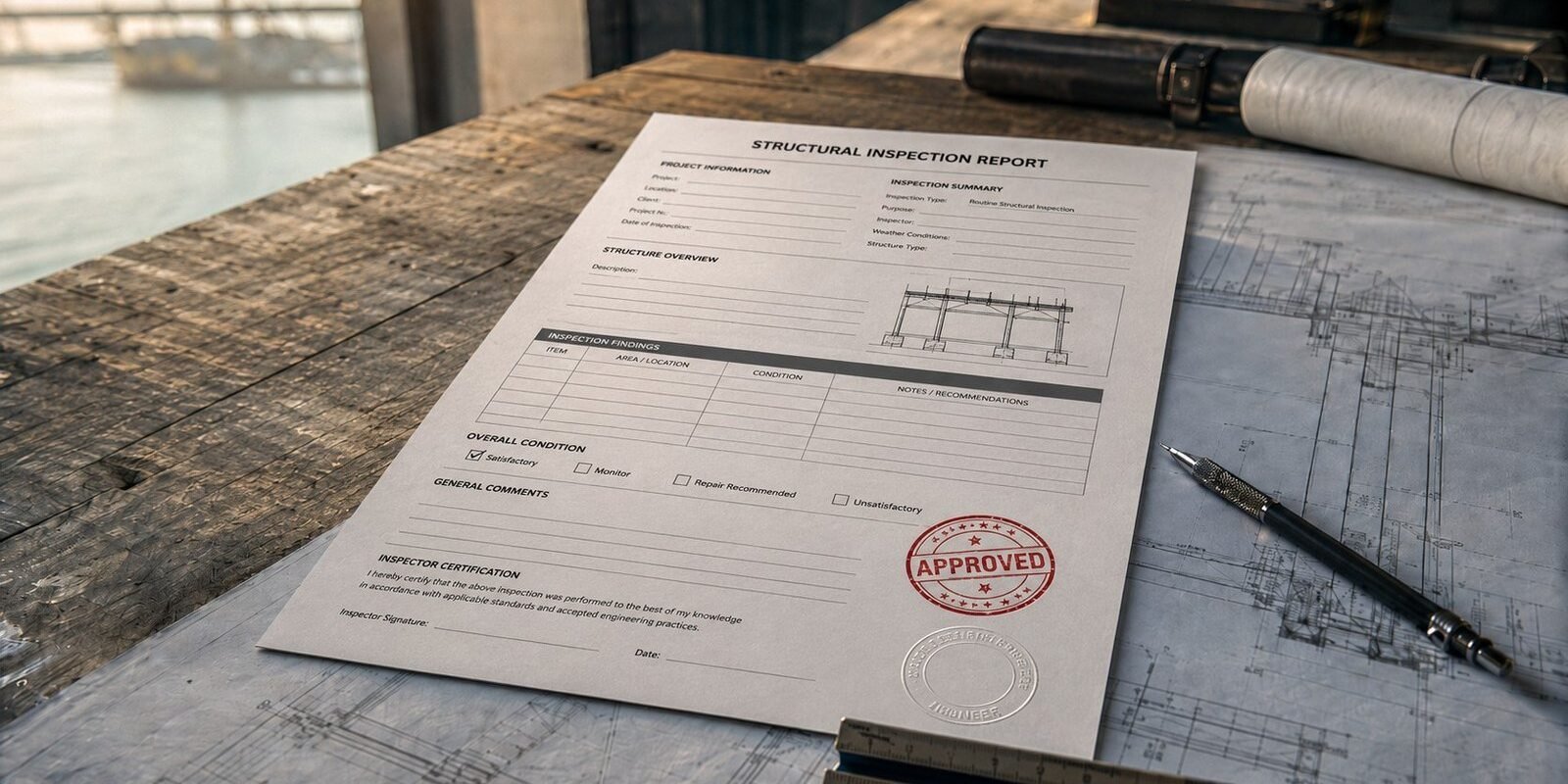
An engineer-sealed inspection report documents existing conditions, assigns a severity rating to each deficiency, identifies the cause of deterioration, and specifies the repair scope needed to return the wall to structural adequacy. That report also serves as the engineering package required to apply for local building permits, Florida DEP authorization, and Miami-Dade DERM review if repair work proceeds.
HOA boards and property managers have an additional consideration: documented assessment creates a record that supports insurance claims, satisfies board fiduciary obligations, and provides defensible documentation in the event of a liability question after a storm or structural incident. See HOA compliance reports for how Souffront structures these assessments for condominium and common-interest communities.
How Souffront Contractors handles seawall assessment in South Florida
Souffront Contractors provides fixed-fee, engineer-led seawall inspections across Miami-Dade, Broward, and Palm Beach counties. Each inspection covers the full structure above and below the waterline. Findings are documented in an engineer-sealed condition report with deficiency ratings and a recommended repair scope. If repair is needed, we develop the structural drawings, manage permitting through FDEP, Miami-Dade DERM, and the local building department, and execute the repair under a single contract. One firm, one point of accountability — from first inspection through final permit closeout.
We serve waterfront property owners, HOA and condominium communities, property managers, and realtors preparing for closings throughout Miami, Fort Lauderdale, Miami Beach, Boca Raton, and across the tri-county region.
Talk to a Florida-licensed engineer
If you are seeing any of the signs described above, contact Souffront Contractors at (877) 420-7220. We provide a fixed-fee scope, a clear assessment timeline, and an engineer-sealed inspection report before any repair recommendation is made. Most inquiries receive a same-business-day response. The contact form is directly below.
Frequently asked questions
What are the first signs a seawall is failing?
The earliest and most common signs are visible cracks in the panel face or cap, rust staining indicating rebar corrosion inside the concrete, and minor ground settlement behind the wall. These early-stage indicators typically appear months or years before structural failure — which is why acting at the first sign rather than waiting for conditions to worsen is consistently the most cost-effective approach in South Florida.
How dangerous is a leaning seawall?
A visibly leaning seawall is a serious structural condition. Lean indicates that the tieback restraint system is no longer providing adequate resistance and that soil pressure is actively displacing the wall outward. The rate of progression depends on soil conditions, tidal loading, and storm exposure — but a leaning wall that is not repaired will continue to move until it fails. Avoid placing heavy loads near a leaning wall and schedule a structural engineering assessment promptly.
What causes sinkholes behind a seawall?
Sinkholes and ground settlement behind a seawall result from soil piping — the migration of fill material through gaps or cracks in the wall into the water. Flow paths form when panel joints open up, cracks reach full panel depth, or weep holes enlarge beyond design size. South Florida’s fine sandy coastal soils are particularly susceptible because particles migrate readily once a flow path exists. Each tidal cycle removes more material, the underground void grows, and the surface above settles or collapses.
Can a failing seawall be repaired without full replacement?
In many cases, yes. Repair options include tieback augmentation (installing new helical or grouted tiebacks alongside deteriorated originals), panel crack repair with epoxy and carbon fiber reinforcement, joint resealing, soil grouting to fill voids behind the wall, and concrete restoration of spalled surfaces. Whether repair is viable versus full replacement depends on the severity and distribution of deterioration, the remaining condition of the existing panels and anchor system, and the cost-benefit analysis specific to the structure. A Florida-licensed structural engineer determines this through a condition assessment — not a field estimate.
How often should a seawall be inspected in South Florida?
For most South Florida waterfront properties, a professional engineering inspection every 2–3 years is a reasonable baseline. Properties in higher-exposure conditions — oceanfront, those that experienced storm surge during a named storm, or walls more than 25 years old — warrant annual inspection. Visual monitoring by the property owner between professional inspections is also valuable: document any new cracks, changes in ground level behind the wall, or changes in water flow through the wall, and report them at the next inspection.
Does seawall condition affect property value or real estate closings?
Yes, significantly. Buyers, lenders, and title companies in South Florida increasingly require seawall condition assessments for waterfront properties. A documented condition assessment from a licensed engineer provides closing-ready evidence that the wall is structurally adequate — or identifies deficiencies that must be resolved or priced into the transaction. Properties with visible seawall deterioration routinely sell at a discount, and some lenders will not close on properties with documented structural deficiencies that have not been addressed or escrowed for repair.
Is rust staining on a seawall always a serious problem?
Not always — but it should never be dismissed without professional evaluation. Light surface staining from iron-bearing groundwater may be benign. But rust staining originating from embedded rebar or tieback hardware — identifiable because it appears at regular intervals or at panel joints consistent with reinforcing locations — indicates corrosion inside the structural concrete. Once rebar corrosion is confirmed, the question becomes how far it has progressed and whether the remaining steel cross-section is still structurally adequate. That determination requires engineering evaluation, not visual inspection alone.
What is the difference between a seawall crack and a seawall joint?
A joint is a designed, intentional gap between adjacent precast concrete panels — placed to accommodate differential movement and thermal expansion. Joints are sealed with rubber gaskets and secondary sealant and require periodic maintenance to remain watertight. A crack is an unintended fracture through a panel or cap caused by structural loading, rebar corrosion expansion, differential settlement, or impact. Joints that are open or degraded need resealing. Cracks need structural evaluation to determine whether they are cosmetic surface fractures or indicators of structural movement — only an engineering assessment can make that determination reliably.
About Souffront Contractors Inc.: a Florida-licensed structural engineering and marine construction firm serving Miami-Dade, Broward, and Palm Beach counties. Schedule a professional seawall inspection with a licensed structural engineer — or call (877) 420-7220.
Got a seawall or structural question?
Five fields. Same business day from a Florida-licensed engineer, routed into our dispatch CRM in real time.
- Same business dayAcknowledgment from a Florida licensed engineer — Mon–Fri 8 AM–5:30 PM.
- Engineer-sealed reportAccepted by carriers, building departments, and real-estate transactions.
- Fixed-fee proposalNo hourly billing. Repair scope priced line-by-line.