
Dock Repair Cost in South Florida: What to Expect
What dock repair costs in South Florida, how the process works, and when you need a Florida-licensed engineer. Real ranges, timelines, and what to watch for.
Dock repair in South Florida typically runs $150–$600 per linear foot for structural work, depending on the type of damage, materials, and whether permits are required — but scope varies widely enough that a professional assessment is always the right first step. Most residential dock repairs in Miami-Dade, Broward, and Palm Beach take two to six weeks from inspection to completion once permits are in hand. The key is catching deterioration early: dock systems in South Florida face some of the most aggressive marine conditions in the country, and small problems become expensive fast.
Key takeaways
- South Florida dock repair costs range roughly $150–$600 per linear foot for structural work; minor decking repairs can run lower.
- Salt water, boat traffic, tropical storms, and marine borers accelerate dock deterioration faster here than in most U.S. markets.
- A permit is almost always required for structural dock repair in Miami-Dade, Broward, and Palm Beach — pulling it yourself or skipping it carries significant legal and insurance risk.
- Most dock repair projects move from inspection to completion in two to six weeks; complex structural work or seawall tie-ins can take longer.
- An engineer-sealed report is frequently required by HOAs, lenders, and insurance carriers before or after dock work.
Why South Florida docks deteriorate faster than you expect
Saltwater is relentless. South Florida docks operate in a mix of tidal flushing, boat wake, and year-round heat and humidity that no structural system handles without maintenance. The two most destructive forces are electrochemical corrosion (which attacks steel hardware, fasteners, and embedded rebar) and marine borers — specifically the shipworm Teredo navalis and Limnoria crustaceans, which bore through untreated timber pilings silently until a structural failure becomes visible. By then, the damage is often well advanced.
Add hurricane loads and storm surge, and a dock that looked serviceable in April can require full piling replacement by September. This is not hyperbole — it is why waterfront property owners in Miami-Dade, Broward, and Palm Beach should schedule dock inspections at least every two years, and immediately after any named storm makes landfall within 50 miles of their property.
The Florida Department of Environmental Protection (DEP) and U.S. Army Corps of Engineers (USACE) also regulate work in navigable waters, which means dock repair often requires state and federal coordination in addition to the local building permit.
Common dock repairs in South Florida — and what they actually cost
No two docks are identical, and cost estimates in this space are notoriously unreliable without an inspection. That said, here are the most common repair categories and representative cost ranges for South Florida conditions in 2026:
Piling replacement
Pilings are the foundation of the dock. When marine borers or corrosion compromise them, there is no repair — only replacement. Concrete or composite pilings in South Florida range roughly $1,200–$3,500 per piling installed, depending on length, diameter, material, and access. Timber pilings are cheaper upfront but rarely advisable in South Florida saltwater without pressure treatment rated for marine use (CCA or better). Most residential docks have 6–16 pilings; a full replacement project can run $15,000–$50,000+ depending on scope.
Decking replacement or resurfacing
Deck boards take constant UV exposure, foot traffic, and water intrusion. Pressure-treated timber, composite decking (Trex or similar), and Ipe hardwood are the common choices. Composite and hardwood cost more upfront but dramatically outlast standard treated lumber in a marine environment. Expect $25–$75 per square foot for deck replacement depending on material and whether structural members below need attention. A typical 400 sq ft residential dock deck runs $10,000–$30,000 depending on material selection and substructure condition.
Framing and stringers
The horizontal framing that supports the deck sits in the splash zone — the worst possible position for a structural member in a marine environment. Galvanized hardware corrodes, timber rots, and composite members perform best but cost more. Framing repairs alone can run $50–$150 per linear foot; combined with decking work, they are almost always addressed in the same mobilization.
Cleats, hardware, and electrical
Dock hardware — cleats, bumper systems, ladders, dock boxes — corrodes faster in South Florida than nearly anywhere in the continental U.S. Stainless steel hardware is standard; galvanized is marginally acceptable; zinc or standard steel is a waste of money in this environment. Electrical systems (shore power pedestals, lighting, bilge pump wiring) require a licensed marine electrician and, in most jurisdictions, a separate electrical permit. Budget $3,000–$12,000 for a full electrical overhaul on a residential dock.
Seawall-to-dock tie-ins
Many South Florida docks are connected directly to the seawall or share structural load with it. When the seawall is compromised, dock stability is affected — and vice versa. If your dock inspection reveals seawall damage, you may be looking at a combined project. Souffront frequently handles both in the same scope to reduce permitting friction and mobilization costs. Learn more about seawall repair and seawall inspection services.
The dock repair process: from inspection to completion
Here is the typical sequence for a structural dock repair project in South Florida:
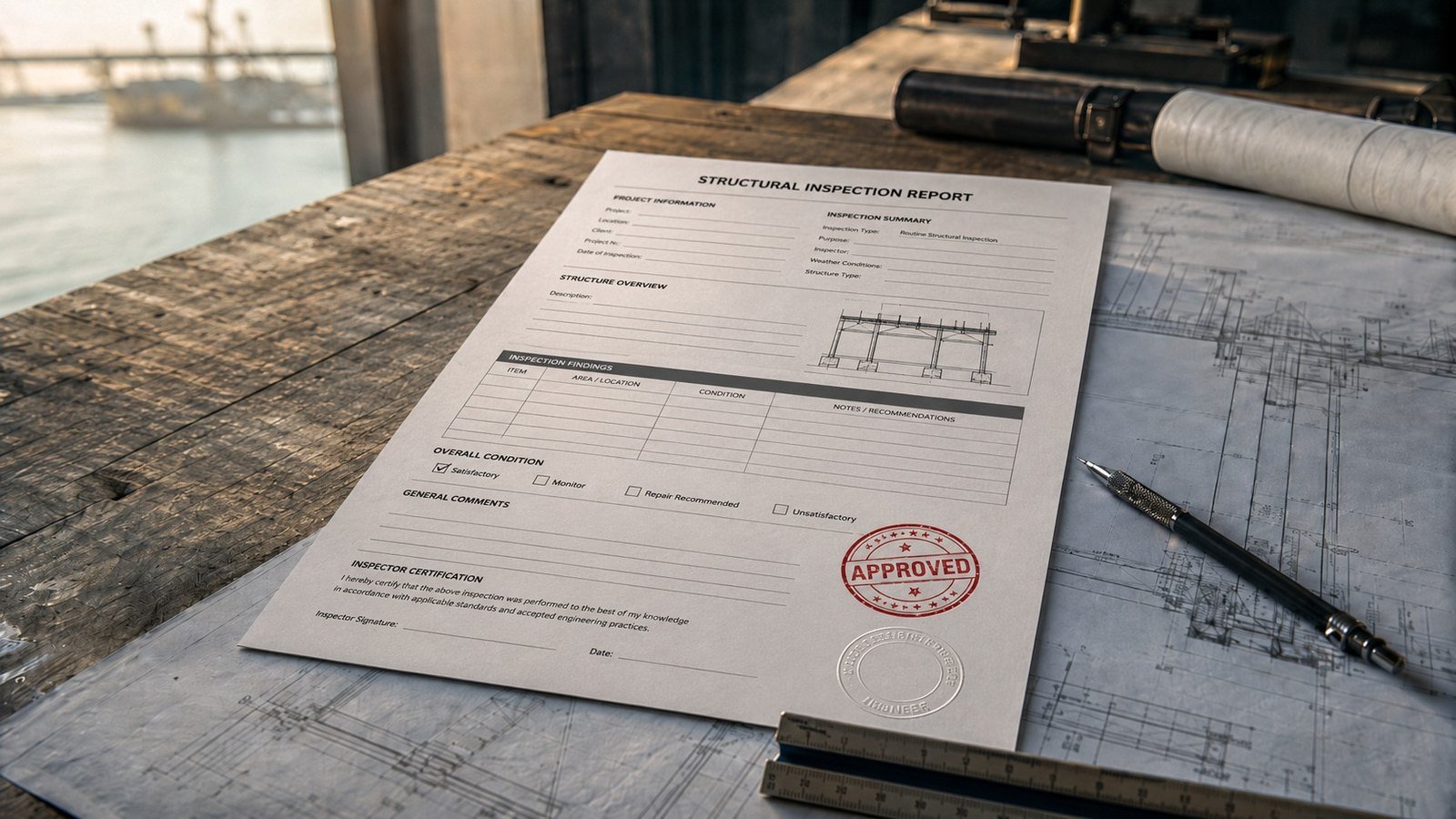
- Inspection. A Florida-licensed structural engineer assesses the dock — above waterline and below, if needed. Photographs document existing conditions. A written report details what needs repair, what can wait, and what is structurally critical. This is not a contractor’s estimate — it is an engineering assessment that stands independently of who does the work.
- Engineering drawings and specifications. Structural repair in navigable waters requires stamped engineering plans for permitting. Souffront prepares these in-house, which eliminates the lag of coordinating between an independent engineer and a contractor.
- Permitting. Depending on scope, permits may be required from: the local building department (Miami-Dade, Broward, Palm Beach), the Florida DEP (coastal construction permit), and the USACE (Section 10 or Section 404 permit). Permit timelines range from two weeks for minor repairs under an existing permit to six months or more for new dock construction or major alterations. Most standard structural repairs on existing permitted docks fall in the two-to-eight-week range.
- Construction. Work typically takes one to three weeks in the field for a standard residential repair. Piling replacement adds time due to driving equipment access.
- Final inspection and sign-off. The building department inspects and closes out the permit. If an engineer-sealed report is required by your HOA, lender, or insurer, it is issued at this stage.
See the full list of dock repair services Souffront provides across South Florida, or explore the floating docks and marina work page for larger commercial projects.
When a repair is not enough: signs your dock needs replacement
Not every dock is worth repairing. Here are the conditions that typically push a project into full replacement territory:
- More than 40–50% of the pilings show marine borer damage or section loss below the waterline
- The cap beam or header connecting the pilings is compromised across most of the dock’s length
- The dock was built before modern materials standards and lacks composite or treated structural members
- Repeated storm damage has affected the overall alignment and load path of the structure
- The dock layout no longer serves the property’s needs — a repair project is an opportunity to redesign
A side-by-side repair vs. replacement cost analysis is something a Florida-licensed structural engineer can run for you before any commitment is made. In many cases, replacement is more cost-effective over a 15-to-20-year horizon than repeated repairs on an aging structure.
Permitting dock work in Miami-Dade, Broward, and Palm Beach
Permitting is where most dock repair projects stall — or where unpermitted work creates serious legal exposure. All three South Florida counties require building permits for structural dock repairs; all three also coordinate with the Florida DEP for work in or adjacent to navigable waters. Unpermitted work can result in stop-work orders, fines, required demolition, and challenges when selling the property.
The Miami-Dade DERM (Department of Environmental Resources Management) has specific shoreline development requirements that affect dock work along Biscayne Bay and other regulated waterways. If your property is in a designated aquatic preserve or adjacent to seagrass, additional environmental review may apply. An engineer who knows the local regulatory landscape saves months of back-and-forth — and avoids costly redesigns after permit rejection.
Souffront handles permitting in-house across Miami-Dade, Broward, and Palm Beach. If you are in Fort Lauderdale, see the Fort Lauderdale service area page for jurisdiction-specific notes.
Talk to a Florida-licensed engineer
If your dock shows signs of deterioration — soft or spongy decking, visible piling damage, loose hardware, or anything that moves when it should not — an engineering assessment is the right first step. Souffront provides fixed-fee dock inspections across South Florida with a clearly quoted price before any site visit, engineer-sealed reports accepted by HOAs and insurers, and a single team that inspects, engineers, permits, and builds. Most inquiries receive a same-business-day response. The contact form is directly below.
Frequently asked questions
How much does dock repair cost in South Florida?
Structural dock repair in South Florida runs roughly $150–$600 per linear foot for most residential projects, depending on materials, scope, and whether piling replacement is involved. Decking-only work on a sound substructure is at the lower end; full piling replacement with new framing and decking is at the upper end or beyond. A proper inspection is the only way to generate an accurate estimate — ballpark figures without an assessment are rarely useful and often misleading.
Do I need a permit to repair my dock in Florida?
Almost always yes, for structural repairs. Florida requires building permits for structural dock work, and work in navigable waters typically requires a Florida DEP coastal construction permit and may require a USACE permit as well. Minor cosmetic repairs — replacing a few deck boards on a sound structure — may fall below the permit threshold, but any work involving pilings, framing, or the seawall tie-in requires permits. Unpermitted structural work creates real liability when selling the property.
How long does dock repair take in South Florida?
From initial inspection to project completion, most standard residential dock repairs take four to eight weeks — two to four weeks for permitting and two to four weeks for construction. Piling replacement projects take slightly longer due to equipment access and cure time. Complex projects involving both dock and seawall work, or permits requiring USACE coordination, can run three to six months. An experienced permitting team can significantly compress timelines by anticipating agency requirements upfront.
What materials hold up best for dock construction in South Florida?
Concrete and composite pilings outperform timber in South Florida’s saltwater environment. For decking, high-density composite or tropical hardwood (Ipe) dramatically outlasts pressure-treated pine in a marine setting. All hardware should be stainless steel; galvanized is marginally acceptable but shows visible corrosion within a few years in most South Florida waterways. The upfront cost difference between quality materials and budget materials is typically recovered within five to seven years in reduced maintenance and repair frequency.
Can I repair a dock myself in South Florida?
Minor cosmetic work — tightening hardware, sanding, staining — does not require a permit or contractor license. Any structural work, including replacing pilings, framing members, or more than a few deck boards, requires a licensed contractor and, in most cases, a permit. Beyond the legal requirement, dock structural work in a marine environment carries real safety risk if done without engineering knowledge. A Florida-licensed structural engineer assessing the dock before any work begins protects you from spending money on the wrong repairs.
How often should I have my dock inspected in South Florida?
Every two years is a reasonable baseline for a well-maintained dock in South Florida saltwater. After any named storm that comes within 50 miles of your property, schedule an inspection regardless of visible damage — underwater piling damage and hardware fatigue are not visible from the dock surface. If your dock is more than 15 years old or was built with timber pilings, annual inspections are advisable.
What is the difference between a contractor estimate and an engineering inspection for a dock?
A contractor estimate tells you what a specific contractor proposes to do and what they will charge. An engineer’s inspection is an independent structural assessment of what the dock actually needs, issued under a professional engineer’s seal and accepted by regulators, HOAs, lenders, and insurers. The engineer’s report defines the scope — the contractor executes it. At Souffront, both happen under the same roof, which eliminates the gap between what an independent engineer specifies and what a separate contractor bids.
Does dock repair affect my seawall?
Frequently, yes — especially when the dock is bolted to or shares structural load with the seawall. Piling driving during dock repair can disturb soil behind the seawall. Conversely, seawall movement can affect dock alignment and hardware loads over time. If you are scheduling dock repair, it is worth having the adjacent seawall assessed at the same time. Addressing both in the same project reduces permitting complexity and total cost. Learn more about seawall inspection and seawall repair services.
About Souffront Contractors Inc.: a Florida-licensed structural engineering and marine construction firm serving Miami-Dade, Broward, and Palm Beach counties. Book a seawall inspection in Miami or anywhere on the South Florida waterfront — or call (877) 420-7220.
Got a seawall or structural question?
Five fields. Same business day from a Florida-licensed engineer, routed into our dispatch CRM in real time.
- Same business dayAcknowledgment from a Florida licensed engineer — Mon–Fri 8 AM–5:30 PM.
- Engineer-sealed reportAccepted by carriers, building departments, and real-estate transactions.
- Fixed-fee proposalNo hourly billing. Repair scope priced line-by-line.