
What Dock Material Lasts Longest in Miami Saltwater?
Concrete, wood and composite docks age differently in Biscayne Bay saltwater. A field comparison of lifespan, cost and maintenance from a licensed engineer.
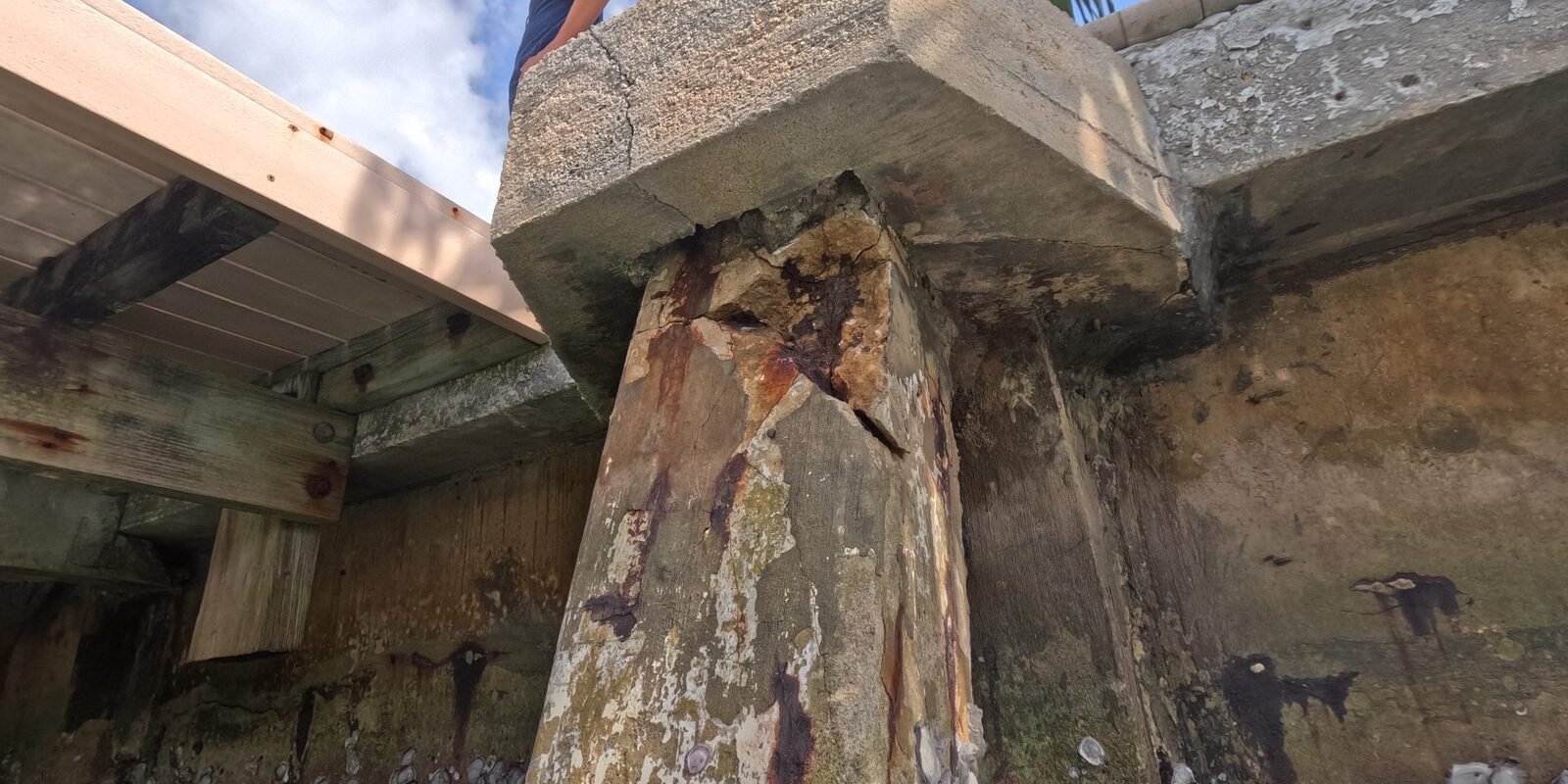
Concrete decking outlasts wood and composite in Miami saltwater, but the pilings underneath it fail first if they’re not marine-grade — so the deck material matters less than most owners think. Souffront Contractors builds and inspects docks across Biscayne Bay, and the failures we see rarely start at the surface. They start below the waterline, where the wrong piling or a skipped wrap quietly does the real damage.
If you’re planning a new dock construction project on a canal in Coconut Grove, a seawall-adjacent lot in Coral Gables, or an island property near Key Biscayne, the deck material you pick is a real decision — but it’s the second decision, not the first. This article walks through what concrete, wood, and composite actually do in saltwater over 10, 20, and 30 years, and where the money is better spent.
Key takeaways
- Pressure-treated pine decking typically lasts 10–15 years in Biscayne Bay saltwater before boards need replacing; the substructure can outlast the decking if pilings are marine-grade.
- Marine-grade composite decking (Trex Transcend, TimberTech AZEK) runs 25–30 years with minimal maintenance but costs more upfront and still needs a treated wood, aluminum, or concrete frame underneath.
- Cast concrete decking on properly sized pilings is the longest-lived option, commonly 30–50 years, but adds weight that changes the piling engineering.
- Marine borers (shipworm, gribble) are active year-round in South Florida’s warm water and are the single biggest reason untreated or improperly treated wood fails early — not weathering.
- Piling material and installation depth matter more to a dock’s lifespan than the decking on top of it.
What actually fails first — the field-notes version
When we get called out to look at a failing dock, the decking is rarely the reason the owner called. It’s a soft spot underfoot, a piling that’s rotated a few degrees, or a bracket pulling loose from a post that’s lost cross-section below the mud line. By the time decking looks bad enough to notice from the yard, the substructure has usually been degrading for years.
That’s the case for treating this as a system decision, not a materials-showroom decision. A concrete dock on undersized or untreated pilings will fail on the same timeline as a wood dock on undersized pilings — the top just looks better while it happens.
Wood docks: still the most common, still the most misunderstood
Pressure-treated pine remains the default choice in South Florida because it’s the cheapest to install and the easiest to repair board by board. In Biscayne Bay saltwater, expect:
- Decking lifespan: 10–15 years before boards need replacing, sooner in full-sun, full-splash zones.
- The real threat isn’t rot — it’s marine borers. Shipworm and gribble attack untreated or under-treated wood below the waterline and can hollow a piling from the inside while the surface still looks sound. This is why piling wrap (a PVC or HDPE jacket installed over the piling in the tidal zone) matters more than the grade of lumber on the deck.
- Fasteners corrode faster than the wood. Standard galvanized hardware degrades quickly in saltwater spray; stainless steel costs more but avoids the rust-streaking and loosening that shows up in year three or four.
Wood is a reasonable choice when the budget is tight and the owner is willing to plan for board replacement on a 10–15 year cycle. It’s a poor choice paired with cheap, unwrapped pilings — that combination is where we see full-dock replacement instead of a repair.
Composite docks: low maintenance, real cost
Marine-grade composite decking (not the residential-grade composite sold for backyard decks — ask specifically for a marine-rated product) resists rot, doesn’t need staining or sealing, and holds up well to UV and salt spray. In practice:
- Decking lifespan: 25–30 years with minimal upkeep beyond periodic cleaning.
- It’s a deck material, not a structural material. Composite boards still sit on a frame — typically treated wood, aluminum, or concrete — so the substructure decision is separate and still governs the dock’s real lifespan.
- Cost is meaningfully higher than pressure-treated pine, generally 40–60% more per square foot for decking alone (general industry range, not a Souffront quote — every dock is scoped and priced individually).
- Heat underfoot in direct Miami sun is a real complaint with darker composite colors — lighter colors perform better for barefoot dock use.
Concrete docks: the longest-lived, the most engineering-dependent
Cast-in-place or precast concrete decking is what you’ll see on higher-end waterfront properties and most commercial marina structures. It doesn’t rot, doesn’t burn, and doesn’t need refinishing. But concrete changes the engineering problem:
- Decking lifespan: commonly 30–50 years when properly reinforced and the substructure is sized correctly.
- Weight is the tradeoff. Concrete decking loads the pilings differently than wood or composite, which means piling size, spacing, and embedment depth all need to be engineered for the added dead load — this isn’t a swap you make without a structural review.
- Rebar corrosion is the failure mode to watch, not the concrete itself. Chloride intrusion from saltwater spray eventually reaches the steel reinforcement; quality of the original pour and cover depth determine how long that takes.
- Highest upfront cost of the three options, offset by the longest service life and the least maintenance.
What matters more than the material you pick
Three decisions affect a Biscayne Bay dock’s lifespan more than concrete-versus-wood-versus-composite:
- Piling material and treatment. Marine-grade treated wood, wrapped wood, concrete, or aluminum pilings, sized and embedded for the local soil and tidal range — not the decking on top.
- Hardware grade. Stainless steel fasteners and brackets throughout, not just at the visible connections.
- Installation quality. A piling driven to the wrong depth or a bracket installed without proper flashing will undercut even the best decking material.
This is the argument for treating a new dock as one project with one marine contractor responsible for the whole system — substructure, hardware, and decking — rather than shopping decking material in isolation. It’s also why a dock builder who also does seawall and piling repair work tends to design a more realistic substructure: they’ve seen what fails.
Permitting: the part owners underestimate
New dock construction anywhere on Biscayne Bay, the Miami River, or an interior canal generally requires permitting through the local municipality plus Miami-Dade DERM for work below the mean high water line, and potentially the U.S. Army Corps of Engineers if the dock extends into navigable water. Design and construction still have to meet the Florida Building Code‘s coastal and wind-load requirements for the zone. Skipping this step — or assuming a like-for-like rebuild doesn’t need a new permit — is one of the more common ways a dock project stalls mid-build.
Talk to a Florida-licensed engineer before you pick a material
Material choice, piling sizing, and permitting are one decision, not three separate ones. Souffront provides a structural engineer inspection and design review before a shovel goes in the water, with a fixed-fee scope quoted upfront — so you know what the substructure needs to support before you commit to concrete, wood, or composite decking. The contact form below gets you a same-business-day response.
Frequently asked questions
What is the best dock material for saltwater in Miami?
Concrete decking has the longest service life in Biscayne Bay saltwater, typically 30–50 years, but requires pilings engineered for the added weight. Marine-grade composite (25–30 years) is the lowest-maintenance option. Pressure-treated wood (10–15 years per decking cycle) is the lowest upfront cost and easiest to repair in sections. The right answer depends on budget, maintenance tolerance, and what the existing or planned pilings can support.
How long does a wood dock last in Biscayne Bay saltwater?
Pressure-treated pine decking typically needs board replacement within 10–15 years in South Florida saltwater. The pilings underneath can last much longer or much shorter than that depending on whether they’re properly treated and wrapped against marine borers — that’s usually the bigger variable.
Are composite docks worth the extra cost in South Florida?
For owners who want to avoid periodic board replacement and don’t mind a higher upfront cost, marine-grade composite decking generally pays for itself in reduced maintenance over a 25–30 year lifespan. It’s a decking choice only — the substructure underneath still needs to be engineered separately.
Can I mix materials — concrete pilings with a wood deck?
Yes, and it’s common. Concrete or marine-grade pilings paired with a treated wood or composite deck is a standard configuration that balances substructure durability with lower decking cost. The engineering still needs to account for the specific load and connection details of whatever decking sits on top.
Do I need a permit to build a new dock in Miami-Dade or Broward?
Almost always. New dock construction on tidal water generally requires a municipal building permit, review under Miami-Dade DERM’s environmental permitting for work below the mean high water line, and potentially U.S. Army Corps of Engineers review if the structure extends into navigable water. Requirements vary by municipality and waterway, so confirm scope before design is finalized.
What ruins a dock faster: material choice or piling installation?
Piling installation, in our experience. A well-chosen decking material on undersized, untreated, or improperly embedded pilings will still fail early — the decking just hides it longer because the damage happens below the waterline first.
How much does a new dock cost per square foot in South Florida?
Costs vary widely by substructure, waterway depth, and material, so a real number requires a site-specific scope. As a general reference point, wood decking runs lowest per square foot, composite runs meaningfully higher, and concrete decking runs highest — but the substructure (pilings, hardware, engineering) is usually a larger share of total cost than the decking material itself.
Does Souffront build docks, or just inspect them?
Both. Souffront Contractors is a Florida-licensed engineering and marine construction firm — the same team that inspects and designs a dock also builds it, so the person specifying the substructure has actually built one. Souffront serves Miami-Dade, Broward, and Palm Beach counties; call (877) 420-7220 or use the form below to start with a structural engineer inspection.
Related from Souffront Contractors: dock repair and HOA and condo board compliance reports — all delivered by the same Florida-licensed structural engineering and marine construction team. Call (877) 420-7220.
About Souffront Contractors Inc.: a Florida-licensed structural engineering and marine construction firm serving Miami-Dade, Broward, and Palm Beach counties. Work with a Florida-licensed seawall contractor who is also the engineer of record — see our seawall contractors page or call (877) 420-7220.
Got a seawall or structural question?
Five fields. Same business day from a Florida-licensed engineer, routed into our dispatch CRM in real time.
- Same business dayAcknowledgment from a Florida licensed engineer — Mon–Fri 8 AM–5:30 PM.
- Engineer-sealed reportAccepted by carriers, building departments, and real-estate transactions.
- Fixed-fee proposalNo hourly billing. Repair scope priced line-by-line.