
Seawall Tieback Corrosion in Miami: How Rods Actually Fail
Why seawall tieback rods and deadmen corrode in Miami's saltwater soil, the warning signs before failure, and what a structural engineer checks first.
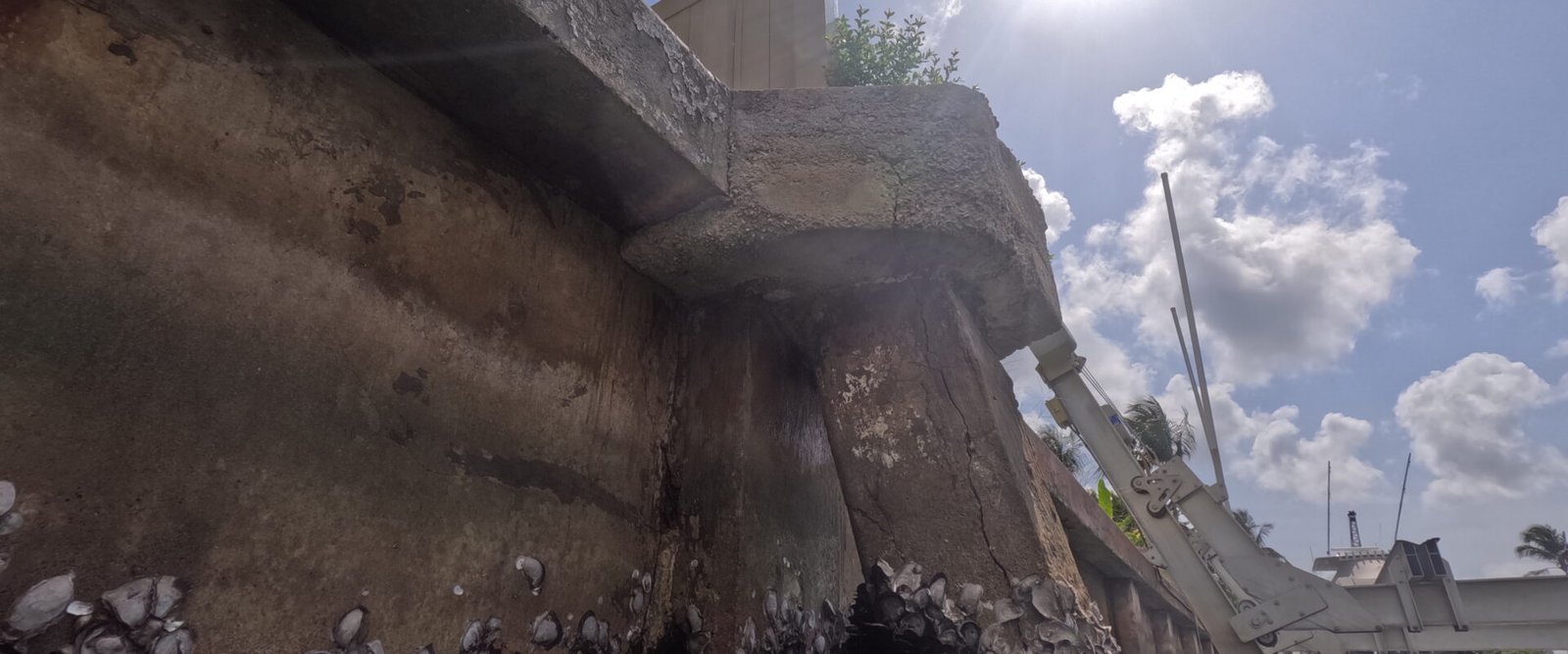
A seawall tieback system fails when the buried steel connecting the wall to its deadman anchor corrodes to the point it can no longer resist soil pressure — usually the tie rod necks down and snaps, or the deadman itself loses enough surrounding soil to slide. In Biscayne Bay neighborhoods like Coral Gables, Coconut Grove, and Key Biscayne, saltwater-saturated soil accelerates this process far faster than most property owners expect. A seawall inspection from Souffront Contractors is built specifically to catch tieback deterioration before the wall shows a visible lean.
Key takeaways
- Tieback systems have three failure-prone parts: the tie rod, the deadman anchor, and the connection hardware (turnbuckles, whalers, nut plates).
- Chloride exposure from Biscayne Bay canal and bay-front soil corrodes buried steel far faster than atmospheric rust — often invisibly, below grade.
- A rod that has lost 20–30% of its cross-section from corrosion can fail suddenly under normal tidal loading, with little visible warning above ground.
- Soil voids near the deadman, cap deflection, and unexplained new cracks in the panel line are the earliest visible clues something is wrong underground.
- A structural engineer inspection is a flat fee, typically $1,500–$3,000 depending on complexity, quoted before any site visit — never priced per linear foot.
What a tieback system actually is
Most South Florida seawalls aren’t freestanding. The wall panel holds back soil and water on its own up to a point, but for real retaining height, it needs help. A tieback system connects the top of the wall (through the cap or a steel whaler) to a buried anchor set back in the yard — the deadman. The tie rod runs between them, usually galvanized or epoxy-coated steel, tensioned to hold the wall from tipping forward.
Deadman — a buried anchor (a concrete block, steel plate, or a battered pile) set back from the wall that the tie rod pulls against to resist soil pressure.
When this system works, the wall barely moves under load. When it doesn’t, the wall tips, cracks, or drops — often with no warning from the waterside, because the failure started underground on the land side.
How the rod actually corrodes
Tie rods don’t usually fail from one cause. In Miami-Dade and Broward waterfront soil, three mechanisms typically combine:
Chloride-driven corrosion
Saltwater intrusion is constant in canal-front and bay-front soil, and chloride ions actively break down the protective oxide layer on steel — unlike fresh water, which mostly just causes surface rust. A rod buried in chloride-saturated soil corrodes from the outside in, often losing cross-section unevenly along its length.
Galvanic corrosion at connections
Where a galvanized rod meets a different metal — a stainless turnbuckle, a bronze fitting, even rebar in the deadman — the two metals form a small battery. The less noble metal corrodes faster at that exact point. This is why turnbuckles and rod-to-wale connections are frequently the first thing to go, not the middle of the rod.
Coating failure and localized pitting
Epoxy-coated rods resist corrosion only as long as the coating stays intact. A scratch during installation, a shifted rod rubbing against a rock, or coating breakdown over time creates one small exposed spot. Corrosion concentrates there instead of spreading evenly, producing a pit that narrows the rod’s cross-section far faster than uniform surface rust would.
How the deadman fails on its own
The anchor doesn’t have to corrode to fail. Deadmen lose holding capacity when:
- Soil migrates around the anchor — sandy or fill soil settles or washes through gaps over years, leaving the deadman with less bearing resistance than it was designed for.
- The anchor was undersized or shallow to begin with — older, informally built walls sometimes used a deadman sized for a much shorter tieback run.
- Groundwater and tidal cycling loosen the surrounding soil — repeated wetting and drying near the water table reduces the soil’s grip on the anchor over time.
A deadman with reduced holding capacity puts more strain on the rod and its connections, which speeds up the corrosion failures above. The two problems compound each other.
Warning signs before the wall visibly leans
By the time a seawall panel is visibly leaning waterward, the tieback system has usually already failed or is close to it. Earlier signs, mostly on the land side, include:
- New or widening cracks running parallel to the wall in the yard, cap, or pavers, tracing where the deadman sits
- A soft or sunken strip of lawn a few feet back from the wall — a sign of soil loss around the anchor
- Rust staining bleeding through the cap near where a tie rod passes through
- A turnbuckle or rod end visibly rusted or seized when the cap is opened for inspection
- Slight but measurable outward movement of the cap compared to prior photos or surveys
None of these are conclusive on their own. That’s why a below-cap and, where warranted, below-waterline inspection matters more than a walk-by visual check.
What a structural engineer checks during inspection
A proper seawall repair assessment starts with locating the tieback system, not guessing at it. That typically means:
- Exposing tie rod connections at the cap to check corrosion, coating condition, and hardware tightness
- Probing or excavating near suspected deadman locations to check for soil voids
- Measuring cap deflection against baseline survey points, where available
- Checking for consistent spacing and depth of tiebacks against what the original design (if it exists) called for
- Documenting findings with photos and a condition rating the property owner or board can act on
Because tieback failure is a below-grade problem, the inspection has to physically verify what’s there — a visual-only walk from the seawall cap misses the failures that actually cause collapse.
Repair options once corrosion is confirmed
Depending on how far corrosion has progressed, a licensed marine contractor can typically address it a few ways:
- Rod replacement — cutting out the corroded rod and installing a new coated rod, sometimes with an upgraded corrosion-resistant alloy
- New deadman installation — if the original anchor has lost holding capacity, a new deadman set at proper depth and distance restores design tension
- Supplemental tiebacks — adding tie rods between existing anchors where spacing was originally too wide
- Full panel and tieback replacement — for walls where corrosion is widespread rather than isolated
Repair costs for tieback and panel work in South Florida generally run in the $100–$250 per linear foot range for moderate scope, and $400–$600 per linear foot for full replacement — these are general industry ranges tied to construction, never to the inspection itself.
Talk to a Florida-licensed engineer
If your cap has new cracks, a soft spot has appeared in the yard, or your seawall is more than a couple of decades old and has never had its tiebacks checked, get it looked at before it becomes an emergency repair. Souffront Contractors provides an engineer-sealed inspection report at a fixed fee, quoted upfront, with the same firm able to design and build the repair if one is needed. Request an inspection through the form below.
Frequently asked questions
How do I know if my seawall’s tiebacks are failing?
The most common early signs are cracks in the yard or cap running parallel to the wall, a soft or sunken strip of lawn a few feet back from the wall, and rust stains bleeding through the cap near a rod. Visible waterside leaning usually means the tieback system has already failed.
How often should tiebacks be inspected?
Most Miami-Dade and Broward waterfront properties benefit from a structural inspection every few years, and sooner after a major storm or if any of the warning signs above appear. Older walls with unknown tieback history should be checked sooner rather than later.
Can a corroded tie rod be replaced without replacing the whole seawall?
Often, yes. If corrosion is isolated to specific rods or connections and the panel itself is sound, a contractor can cut out and replace individual rods or add supplemental tiebacks. Widespread corrosion across many rods usually points toward broader repair.
Why does saltwater soil corrode tie rods faster than fresh water?
Chloride ions in saltwater actively break down the protective layer that normally slows steel corrosion, instead of just causing surface rust. Canal-front and bay-front soil in areas like Coconut Grove and Key Biscayne stays chloride-saturated year-round, which accelerates corrosion compared to inland fresh-water sites.
What is a deadman anchor?
A deadman is the buried anchor — a concrete block, steel plate, or battered pile — set back from the seawall that the tie rod pulls against. It’s what actually resists the soil pressure trying to push the wall forward; the rod is just the connection between the wall and the anchor.
How much does a seawall inspection cost in Miami?
A structural seawall inspection is a flat fee, typically $1,500–$3,000 depending on the complexity of the inspection — access, whether a below-waterline check is needed, and the number of structural components involved. It’s never priced by wall length, and the fee is quoted before any site visit.
Can I see if tiebacks are failing without digging?
Visual clues like cracking, cap movement, and rust staining can suggest a problem, but confirming it requires physically checking the connections at the cap and probing near the deadman for soil voids. A visual-only walk from the top of the wall will miss most below-grade tieback failures.
Does homeowners insurance cover tieback failure?
Coverage varies significantly by policy and cause of failure, and gradual deterioration is frequently excluded. Check your specific policy language and consult your insurer directly — an engineer’s inspection report documenting the cause and extent of damage is often required regardless of the outcome.
About Souffront Contractors Inc.: a Florida-licensed structural engineering and marine construction firm serving Miami-Dade, Broward, and Palm Beach counties. Get seawall repair in Coral Gables and across Miami-Dade County — see our seawall contractors page or call (877) 420-7220.
Got a seawall or structural question?
Five fields. Same business day from a Florida-licensed engineer, routed into our dispatch CRM in real time.
- Same business dayAcknowledgment from a Florida licensed engineer — Mon–Fri 8 AM–5:30 PM.
- Engineer-sealed reportAccepted by carriers, building departments, and real-estate transactions.
- Fixed-fee proposalNo hourly billing. Repair scope priced line-by-line.