
Marine Concrete Cover Requirements for Seawalls
Marine concrete cover requirements aren't the same as a house slab. See the exact cover depths, rebar spacing, and mix design a seawall needs to survive saltwater.
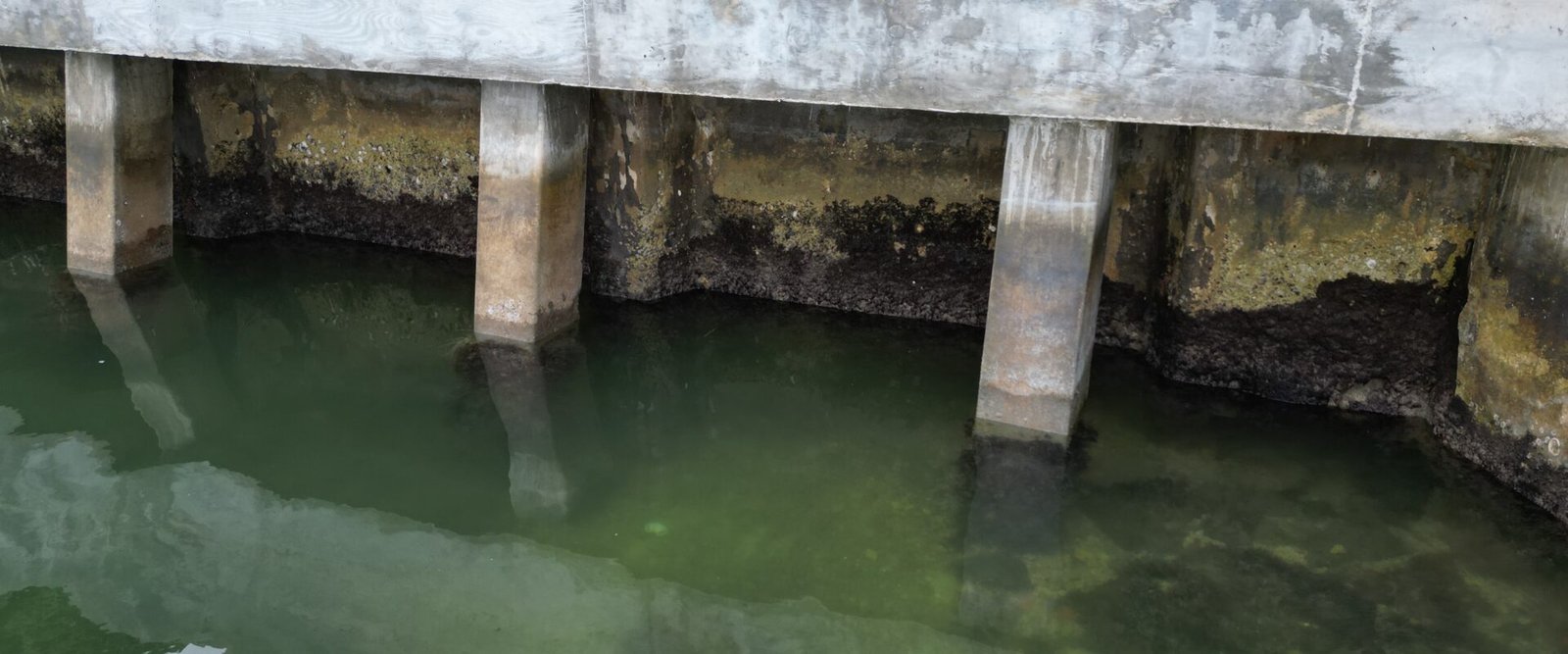
Marine concrete cover requirements are set well above standard building code minimums because saltwater attacks reinforcing steel in a way dry-land concrete never faces. On a seawall along Biscayne Bay in Coral Gables or Key Biscayne, the concrete cover over rebar typically needs to be 3 inches in the tidal and splash zones, roughly double what a typical residential footing calls for. Get that number wrong and the wall looks fine for a decade, then fails from the inside out.
This is the kind of detail a structural engineer checks on every set of seawall plans before construction starts, because it’s the single biggest factor in how long a seawall lasts once it’s built. Souffront Contractors designs, permits, and builds to these specs directly — no interpretation lost between the engineer of record and the crew pouring concrete.
Key takeaways
- Marine concrete typically requires 3 inches of cover over reinforcing steel in the splash and tidal zones, versus 1.5–2 inches for standard dry-land concrete.
- Chloride ions from saltwater migrate through concrete and corrode rebar; deeper cover and tighter rebar spacing slow that migration.
- ACI 357 (guide for marine concrete) and the Florida Building Code both drive the water-cement ratio down to 0.40 or lower for structures in a marine exposure.
- The splash zone — where waves and tide wet and dry the concrete repeatedly — corrodes faster than concrete that stays fully submerged or fully dry.
- Epoxy-coated, stainless, or fiberglass (FRP) rebar is common in the most exposed sections of a new seawall cap or panel.
Why saltwater changes the rules
Plain concrete is alkaline, and that alkalinity forms a passive protective film on steel rebar that normally stops it from rusting. Chloride ions from seawater break down that film. Once enough chloride reaches the rebar, corrosion starts, and rusting steel expands — sometimes to several times its original volume. That expansion cracks and spalls the concrete around it from the inside, which is why a seawall cap can look intact on the surface while the steel underneath is already failing.
Concrete cover is the depth of concrete between the outer surface and the reinforcing steel. It’s the physical barrier chloride has to cross before it reaches the rebar. More cover means more distance, and more time before corrosion starts — often the difference between a seawall that needs cap repair at year 15 and one that needs it at year 40.
How much cover a seawall actually needs
Cover requirements scale with how exposed the concrete is to salt and moisture cycling:
- Interior, dry-side construction (a garage slab, an inland footing): 1.5 inches is standard.
- Concrete exposed to weather but not saltwater spray: typically 2 inches.
- Marine splash, tidal, and atmospheric zones — a seawall cap, panel, or dock piling: 3 inches is the common target under ACI 357 guidance, and some engineers specify more on critical members.
These numbers are measured to the nearest bar, not to the average of the reinforcing mat, and they have to be held during the pour — not just specified on paper. A form that shifts, or rebar that isn’t chaired up properly before the concrete truck arrives, can turn a 3-inch spec into an inch and a half in practice. That’s a jobsite quality-control problem, and it’s one reason an engineer-sealed inspection report on new seawall construction matters — someone independent has to verify cover before the pour is covered up for good.
Rebar spacing and crack width control
Cover depth is half the equation. The other half is how tightly the rebar is spaced. Wider bar spacing means wider, more spread-out cracks when the concrete shrinks or flexes — and wide cracks give chloride a direct shortcut straight to the steel, bypassing the cover entirely. Marine concrete specs generally call for tighter bar spacing and smaller crack-width limits than a standard slab, specifically to keep any cracking fine and shallow rather than wide and structural.
This is also why the reinforcing detail at a seawall’s tiebacks and cap joints gets extra scrutiny. Those are the points where the concrete is most likely to crack first, and where a spacing shortcut shows up soonest as visible rust staining or spalling.
Water-cement ratio and cement type
Cover and spacing only work if the concrete itself resists chloride penetration. A low water-cement (w/c) ratio — commonly 0.40 or lower for marine exposure, versus 0.50+ for ordinary construction — produces denser, less permeable concrete that slows chloride migration on its own. Many marine mix designs also use Type II or Type V cement, or supplementary materials like fly ash or slag, both of which improve sulfate and chloride resistance in a bay or ocean-facing structure.
None of this is optional guidance. Florida Building Code, HVHZ provisions, and Miami-Dade DERM permit review all point back to these marine-exposure requirements for new construction on tidal waterways.
The three exposure zones on every seawall
Corrosion rate isn’t uniform up and down a seawall. Engineers generally split it into three zones:
- Submerged zone — permanently underwater. Low oxygen slows corrosion even though the concrete is constantly wet.
- Splash/tidal zone — wetted by tide and wave action, then exposed to air. Repeated wetting and drying with plenty of oxygen makes this the most aggressive zone on the whole structure, and it’s usually right where the cap and upper panels sit.
- Atmospheric zone — above normal splash, exposed mainly to salt-laden air. Slower corrosion than the splash zone, but still faster than an inland structure.
A seawall cap almost always sits in or near the splash zone, which is exactly why cap replacement is one of the most common repairs Souffront sees on aging Biscayne Bay corridor seawalls — Coral Gables, Coconut Grove, and Key Biscayne properties included.
How this shows up during an inspection or repair
On an existing wall, a structural engineer can’t always measure cover without opening the concrete, but there are visible signals that point to inadequate cover or spacing from the original construction: rust staining bleeding through the surface, hairline cracks following a rebar pattern, or spalling concentrated at the cap and tie-back locations rather than spread randomly. Those patterns are part of what gets documented in a seawall inspection, and they directly inform whether the right fix is patch repair, full cap replacement, or a broader concrete restoration scope.
On new construction or a full rebuild, cover and spacing are two of the easiest specs to get wrong under schedule pressure and two of the hardest to fix after the concrete cures — which is why they belong on the drawings, in the pour inspection, and in the closeout documentation, not just in a general note that says “per code.”
Talk to a Florida-licensed engineer
If you’re planning new seawall construction, a cap replacement, or you’ve spotted rust staining or cracking on an existing wall, get a Florida-licensed structural engineer on it before more concrete gets poured or covered up. Souffront Contractors inspects, engineers, permits, and builds seawalls across the Biscayne Bay corridor and greater Miami-Dade and Broward, with a fixed-fee inspection quoted upfront and same-business-day response. Call (877) 420-7220, or use the form below to schedule.
Frequently asked questions
How much concrete cover does a seawall need over the rebar?
Most seawall concrete in the splash and tidal zones needs about 3 inches of cover over the reinforcing steel, roughly double the 1.5 inches typical of a standard dry-land footing. The exact figure comes from the engineer’s mix design and exposure classification, following ACI 357 marine concrete guidance.
Why does rebar spacing matter for a marine structure?
Tighter rebar spacing keeps shrinkage and stress cracks narrow instead of wide. Narrow cracks limit how quickly chloride from saltwater can reach the steel; wide cracks create a direct path around the concrete cover altogether.
What is the splash zone and why does it corrode faster?
The splash zone is the section of a seawall repeatedly wetted by waves and tide, then exposed to air. That wet-dry cycling combined with high oxygen exposure makes it the fastest-corroding zone on the wall, which is why seawall caps — usually located in or near the splash zone — are the most common repair.
Is epoxy-coated rebar necessary for a new seawall?
It’s common on the most exposed members, like caps and upper panels, especially in aggressive tidal locations. Epoxy-coated, galvanized, stainless, or fiberglass (FRP) rebar all add a layer of corrosion resistance beyond standard cover and mix design, and the engineer of record specifies which one fits the project’s exposure and budget.
What water-cement ratio should marine concrete use?
Marine concrete typically targets a water-cement ratio of 0.40 or lower, compared to 0.50 or higher for ordinary construction. A lower ratio produces denser concrete that resists chloride penetration significantly better.
How would I know if my existing seawall’s concrete cover is too shallow?
Rust staining bleeding through the surface, cracks that trace a rebar pattern, and spalling concentrated at the cap or tie-back locations are all signs cover may be inadequate. A structural engineer confirms this during a seawall inspection, sometimes with a concrete cover meter or by exposing a small test area.
Does Florida Building Code require these marine concrete specs?
Yes. Florida Building Code and HVHZ provisions incorporate marine-exposure concrete requirements, and Miami-Dade DERM permit review checks new tidal-waterway construction against them before issuing a permit.
Who verifies concrete cover and rebar spacing during construction?
On a Souffront project, the same firm that engineers the seawall also builds it and inspects the reinforcing steel placement before the pour, then documents cover and spacing in the engineer-sealed closeout report — removing the gap that happens when the design engineer and the construction crew are different companies with no one checking the handoff.
Related from Souffront Contractors: seawall repair and engineer-led construction management and owner’s representative services — all delivered by the same Florida-licensed structural engineering and marine construction team. Call (877) 420-7220.
About Souffront Contractors Inc.: a Florida-licensed structural engineering and marine construction firm serving Miami-Dade, Broward, and Palm Beach counties. Learn more about engineer-led seawall repair across South Florida — see our seawall contractors page or call (877) 420-7220.
Got a seawall or structural question?
Five fields. Same business day from a Florida-licensed engineer, routed into our dispatch CRM in real time.
- Same business dayAcknowledgment from a Florida licensed engineer — Mon–Fri 8 AM–5:30 PM.
- Engineer-sealed reportAccepted by carriers, building departments, and real-estate transactions.
- Fixed-fee proposalNo hourly billing. Repair scope priced line-by-line.