
Why North Miami Beach Seawalls Fail at the Waterline
Field notes on Eastern Shores and Maule Lake seawalls: why tidal flow and old construction cause different damage, and what a real seawall inspection checks.
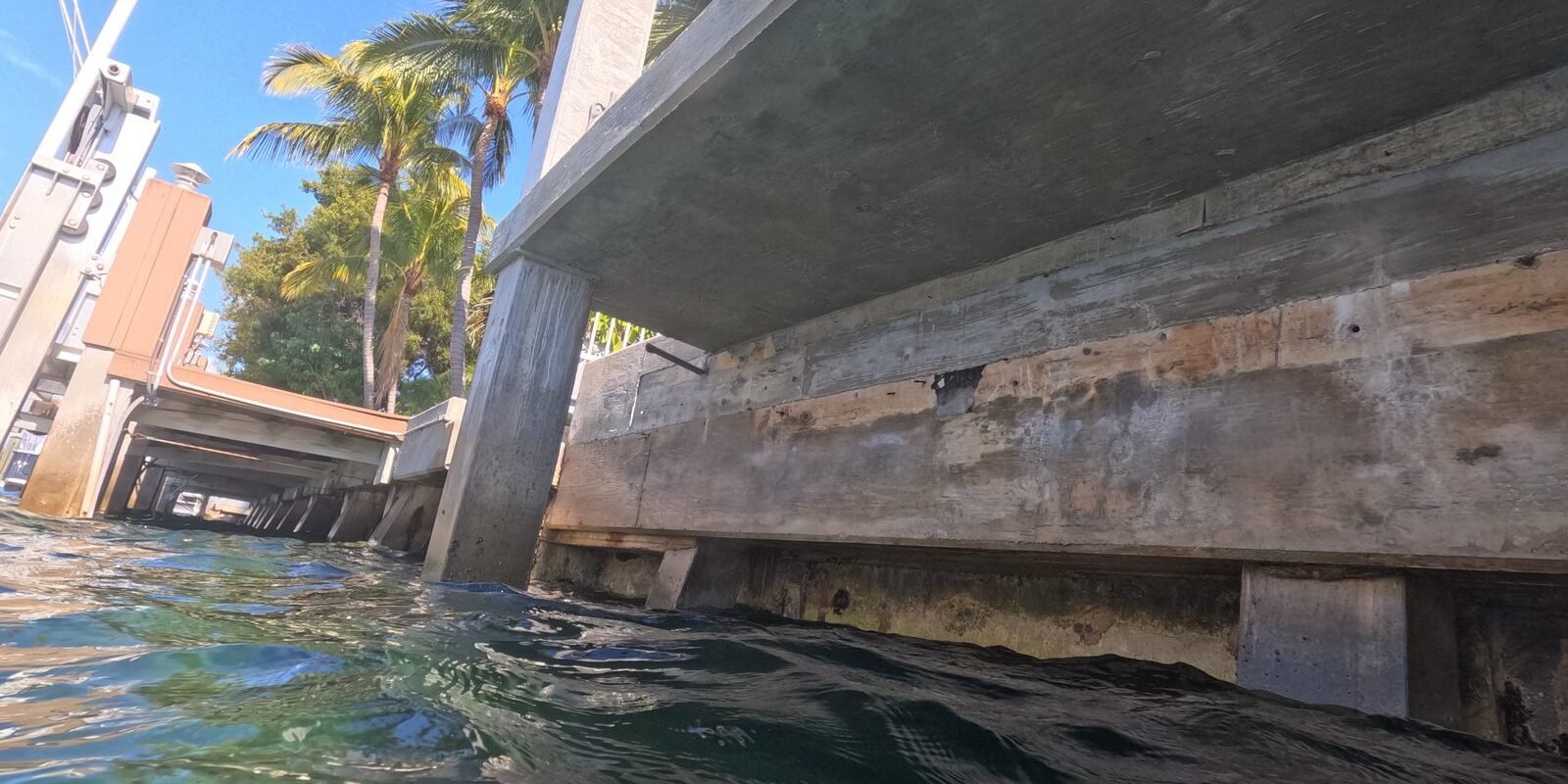
A seawall inspection in North Miami Beach has to start with the water, not the wall. Maule Lake and the Eastern Shores canals behave differently than open Biscayne Bay, and that changes where damage shows up first and how fast it moves. Souffront Contractors has walked enough of these seawalls to know the pattern before we cut the first core sample.
Maule Lake was a limestone rock quarry before it was a lake. It’s deep — in places well over 100 feet — and it connects to the Intracoastal Waterway, which means real tidal exchange moves through it twice a day. Eastern Shores’ finger canals branch off that lake and off Biscayne Bay to the south. Same neighborhood, two different water conditions, two different seawall problems.
Key takeaways
- Maule Lake’s quarry-carved depth and tidal connection to the Intracoastal put more current load on seawalls than a typical bay-front canal.
- Eastern Shores canal seawalls, mostly built in the 1950s–60s, show tie-rod corrosion and cap cracking as their earliest visible signs of distress.
- A structural engineer inspection checks the cap, the panels, the tiebacks and the soil behind the wall — not just what’s visible above the waterline.
- A residential seawall inspection here typically runs $1,500–$3,000 flat fee, quoted before the site visit, based on complexity rather than linear footage.
- Boat wake on Maule Lake, funneled between narrower canal mouths, adds a repeated load older walls weren’t engineered to absorb.
Why Maule Lake’s history changes what we look for
Most Biscayne Bay seawalls sit against a relatively shallow, gently sloped bottom. Maule Lake’s bottom drops off fast because it used to be mined. That depth means more water volume moving in and out with the tide, and more hydrostatic pressure pushing against the back of a seawall at low tide when the soil behind the wall is still saturated and the water in front of it has dropped.
On inspections along the lake, we look first at the toe — the base of the wall below the waterline — for scour and undermining. A wall that looks fine at the cap can already have several feet of soil loss at the toe from years of that pressure differential working the same joint twice a day.
Eastern Shores canals: a different failure pattern
The finger canals in Eastern Shores are narrower and shallower than the open lake, and most of the seawalls lining them date to the neighborhood’s original 1950s and 1960s construction. Two things show up consistently:
- Tie-rod corrosion — the steel rods anchoring the cap to the deadmen buried in the yard were rarely coated to today’s standard. Decades of brackish water exposure thin them from the inside, and the first sign is often a cap that’s begun to lean or separate at a joint, not a visible rod.
- Panel rotation at low points — older concrete panels set without modern reinforcement can rotate outward a fraction of an inch a year. It’s slow enough that owners don’t notice until a paver patio or seawall cap develops a visible gap.
Neither failure mode announces itself loudly. That’s the case for a scheduled inspection rather than waiting for a crack you can see from the dock.
What we actually find on North Miami Beach seawalls
Pulling from recent field visits across Eastern Shores and the Maule Lake shoreline, the recurring findings are:
- Hairline to moderate cracking along the top of the cap, usually starting at expansion joints
- Rust staining bleeding through the concrete face — a visual flag for corroding rebar underneath
- Voids behind the cap where soil has washed out through gaps in aging panels, sometimes under a pool deck or patio slab
- Marine growth and barnacle buildup thick enough to mask hairline cracks during a surface-only look
- Weep holes clogged or entirely absent on walls built before drainage requirements were standard
None of these are visible from the yard. They’re why a real inspection includes time at and below the waterline, not a walk-by from the seawall cap.
Boat wake and tidal current: the load your seawall wasn’t built for
Maule Lake carries more boat traffic than a typical residential canal because it’s a through-route between the Intracoastal and inland docks. Wake action against a seawall is a repeated hydraulic load, and at canal mouths and narrower stretches that wake energy concentrates instead of dissipating. A wall engineered in the 1960s for calm residential water is absorbing more cyclical stress today than it was designed for — one more reason these walls deserve periodic professional review rather than an assumption that “it’s held up this long.”
When repair works and when you’re looking at replacement
Most of what we find in Eastern Shores and along Maule Lake is repairable if it’s caught before the tiebacks fail completely. Cap repair, tie-rod replacement, and soil injection behind the wall to fill voids are common fixes, generally running $100–$250 per linear foot depending on scope. Full panel and tieback replacement, needed when a wall has rotated significantly or lost structural connection at multiple points, runs closer to $400–$600 per linear foot. These are general repair ranges, not a quote — actual seawall repair cost depends on what the inspection finds.
The deciding factor is almost always the tiebacks and the soil behind the cap, not how the concrete looks from the water. That’s why the inspection report matters more than a visual opinion from a seawall contractor walking the dock.
What a seawall inspection in North Miami Beach includes
A proper inspection covers the cap, the panels, the piles or tiebacks, drainage, and the soil condition behind the wall, both above and below the waterline. For walls on deeper water like Maule Lake, that usually means a below-waterline dive component to check the toe and lower panel sections directly, not just a surface read. The report should come back as an engineer-sealed document your HOA board, insurer, or a buyer’s attorney can rely on — not a sales estimate dressed up as an assessment.
Talk to a Florida-licensed engineer
If your Eastern Shores or Maule Lake seawall is showing cap cracking, rust staining, or a cap that’s started to separate at a joint, get it looked at before the next storm season tests it. Souffront provides a fixed-fee, engineer-sealed seawall inspection quoted before we set foot on the property, with a same-business-day response to your request. The scheduling form is right below.
Frequently asked questions
How much does a seawall inspection cost in North Miami Beach?
A residential seawall inspection in North Miami Beach, including Eastern Shores and the Maule Lake shoreline, typically runs $1,500–$3,000 as a flat fee. The price depends on the complexity of the inspection — access, whether a below-waterline dive is needed, and the number of structural components — not on the wall’s linear footage. The fee is quoted before any site visit.
Why do Maule Lake seawalls deteriorate differently than bay-front walls?
Maule Lake was originally a limestone quarry and is significantly deeper than typical Biscayne Bay canals. Combined with its tidal connection to the Intracoastal Waterway, that depth creates stronger hydrostatic pressure and current against seawalls, leading to toe scour and soil loss that isn’t visible from above the waterline.
What are the warning signs my North Miami Beach seawall needs repair?
Common signs include hairline cracking along the cap, rust staining bleeding through the concrete, a cap that has separated slightly at an expansion joint, a paver patio or slab settling near the seawall, and visible panel leaning or rotation. Any of these warrant a structural engineer inspection rather than a wait-and-see approach.
Does the Eastern Shores HOA require seawall inspections?
Requirements vary by association and change over time, so owners should confirm current governing documents directly with their HOA board. Independent of any association requirement, an inspection is the only way to know the actual condition of the tiebacks and soil behind the cap, since neither is visible from the yard or dock.
How does tidal flow through Maule Lake affect seawall condition?
Maule Lake’s connection to the Intracoastal Waterway means water levels rise and fall with the tide twice daily. At low tide, saturated soil behind a seawall still exerts pressure while the water level in front of the wall has dropped, increasing the net outward force on the wall — a cycle that repeats daily and accelerates existing weak points.
Who regulates seawall repair in Miami-Dade County?
Seawall repair and replacement in Miami-Dade County typically requires permitting through Miami-Dade DERM for environmental and coastal work, along with local building department review. Work in or over navigable water connected to the Intracoastal, like Maule Lake, may also involve U.S. Army Corps of Engineers coordination depending on scope.
How long does a seawall inspection take?
A standard residential seawall inspection generally takes a few hours on-site, covering the cap, panels, drainage, and visible structural components, plus a below-waterline check where warranted. The engineer-sealed report typically follows within several business days.
What’s the difference between seawall repair and full replacement?
Repair addresses localized damage — cap cracking, isolated tie-rod failure, soil voids — and is appropriate when the wall’s overall structural connection is intact. Replacement is warranted when panels have rotated significantly, multiple tiebacks have failed, or the wall has lost structural integrity across a large section. An inspection report is what determines which category a given wall falls into.
Related from Souffront Contractors: HOA and condo board compliance reports and dock repair — all delivered by the same Florida-licensed structural engineering and marine construction team. Call (877) 420-7220.
About Souffront Contractors Inc.: a Florida-licensed structural engineering and marine construction firm serving Miami-Dade, Broward, and Palm Beach counties. Schedule a professional seawall inspection with a licensed structural engineer — see our seawall contractors page or call (877) 420-7220.
Got a seawall or structural question?
Five fields. Same business day from a Florida-licensed engineer, routed into our dispatch CRM in real time.
- Same business dayAcknowledgment from a Florida licensed engineer — Mon–Fri 8 AM–5:30 PM.
- Engineer-sealed reportAccepted by carriers, building departments, and real-estate transactions.
- Fixed-fee proposalNo hourly billing. Repair scope priced line-by-line.