
Who’s Watching Your Seawall Project in Coral Gables?
A Coral Gables board with no engineer of its own can't tell a real change order from a bid gap. Here's what an owner's representative actually catches.
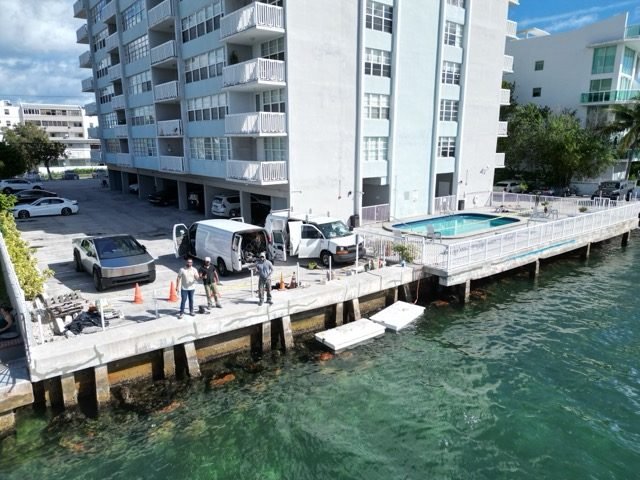
A seawall project falls apart when no one on the association’s side is checking the work day to day. In Coral Gables and up and down Biscayne Bay, boards routinely run six-figure seawall jobs with the engineer who wrote the original report long gone, a contractor who answers to no one but himself, and nobody in between reading the drawings against what’s actually going in the ground. That gap is why boards bring in an owner’s representative for seawall projects — one Souffront Contractors structural engineer who stays on the job from scope to closeout.
Key takeaways
- Most condo and HOA seawall projects have no one on the owner’s side who reads structural drawings once the contract is signed.
- An owner’s representative — also called a construction manager or project manager — reviews submittals, observes work at the milestones that matter, checks pay applications, and evaluates change orders before the board pays for them.
- A real differing condition and a bid gap look identical to a board of volunteers; they don’t look identical to a structural engineer.
- Souffront discloses in writing when it has an interest in bidding the repair work itself, and boards can hire the firm for oversight only.
- Fees for this service are scoped and quoted per project before work starts — never bundled with inspection pricing.
What fragmented oversight actually looks like on site
Here’s a scene that repeats itself on waterfront jobs from Coconut Grove to Sunny Isles Beach: the contractor backfills behind a new seawall cap before anyone confirms the tiebacks were torqued to spec. Nobody was there to see it happen, because nobody on the board’s side was assigned to be there. Six months later, the wall shows movement, and there’s no record proving whether the anchor system was installed correctly — just a signed pay application saying the work was done.
That’s not a hypothetical failure mode. It’s what happens by default when a seawall contractor reports only to itself and the board’s only technical document is the original inspection report, written by an engineer who isn’t on site during construction.
The board’s blind spot: reading drawings and invoices
A condo or HOA board is made up of volunteers — a retired accountant, a realtor, someone who owns a unit and shows up to meetings. None of them are trained to read a structural drawing, evaluate a submittal, or tell whether a $180,000 change order reflects a real differing condition in the soil or a scope gap the low bidder left out to win the contract. When that change order lands in the board’s inbox, the choice is binary and unfair: approve it on faith, or reject it and risk stalling a project that’s already underway.
This is the exact decision a project manager exists to make instead of the board. An owner’s representative reads the geotechnical data, compares it against the original bid documents, and tells the board in plain language whether the number is legitimate.
What one point of contact actually covers, scope to closeout
Construction management on a seawall project is also called owner’s representative work, or owner’s agent work: the construction manager becomes the board’s single point of contact for everything technical, from the first bid package to the final walkthrough. Concretely, that means:
- Scope and bid documents — writing the specification so competing contractors are bidding the same job, not three different ones.
- Bid review — telling the board what the lowest bid actually excludes before they pick it.
- Submittal and shop drawing review — verifying the materials and details delivered match what was specified.
- Site observation at the milestones that matter — tieback installation and torque, cap pour, backfill, panel alignment.
- Pay application review — confirming the work billed is the work actually in the ground before the board releases payment.
- Change order evaluation — separating a genuine differing site condition from a bid gap the board would otherwise absorb.
- Permit and agency coordination — Miami-Dade DERM, the local building department, and FDEP where a project reaches state waters.
- Closeout — as-builts, warranties, and documentation the current board can hand to the next one.
None of that requires the owner’s representative to supervise the contractor’s crew, their means and methods, or jobsite safety — that responsibility stays with the licensed contractor performing the work. The engineer’s job is to observe, review, verify, advise, and document on the board’s behalf.
Why this matters more along the Biscayne Bay corridor
Coral Gables, Coconut Grove, and Key Biscayne have some of the highest concentrations of aging seawalls tied to condo and HOA associations in South Florida — many on canal-front or island lots where a wall failure affects a shared property line, not just one owner’s backyard. A seawall project on Sunset Islands or along the Coral Gables waterway typically touches multiple owners, a homeowners’ association budget, and sometimes a neighboring seawall the association doesn’t own but can’t ignore. The same engineers at Souffront Contractors who perform the structural engineer inspection that identifies the problem can also stay on as the board’s project manager through construction — which means the person overseeing the work has actually built seawalls, not just read about them.
Handling the dual role honestly
Souffront both provides seawall construction management and performs seawall repair and construction work. A board should know that up front. When a board engages Souffront for oversight only, that’s the entire engagement — no obligation to also hire Souffront as the contractor. If Souffront has any interest in bidding the repair work itself on a project where it’s also serving as owner’s representative, that interest is disclosed to the board in writing before bids go out. A board that wants a fully independent construction manager, with zero involvement in construction, can ask for that arrangement directly.
Talk to a Florida-licensed engineer
If your board is about to bid a seawall project — or already has a contractor on site and no one checking the paperwork against the wall — a Florida-licensed structural engineer can review where things stand before the next pay application gets signed. Seawall project management for HOA boards is scoped and quoted per project, before anything starts. Reach Souffront at (877) 420-7220, or use the form below to set up a call.
Frequently asked questions
What does an owner’s representative do on a seawall project?
An owner’s representative is a structural engineer who acts as the board’s single point of contact through a seawall project — writing bid documents, reviewing submittals, observing construction at key milestones, checking pay applications, evaluating change orders, and coordinating with permitting agencies. The role represents the owner’s interests, not the contractor’s.
Is construction management the same as being the general contractor?
No. An owner’s representative or construction manager works for the board and reviews the contractor’s work; the general contractor is a separate party performing the physical construction. On a seawall project, keeping those roles distinct — or disclosing clearly when one firm does both — is what lets the board trust the paperwork.
Does a condo or HOA board need a project manager if they already hired an engineer for the inspection report?
Usually yes. The engineer who wrote the original inspection report typically isn’t on site during construction unless specifically retained to stay on. Without that continuation, no one is checking the contractor’s submittals, pay applications, or change orders against the original scope once work begins.
How much does seawall project management cost?
It’s scoped and quoted per project before work starts, based on the size and complexity of the job — there’s no flat industry rate. This is separate from inspection pricing: a standalone structural seawall inspection typically runs $1,500–$3,000, quoted upfront, but that range doesn’t apply to ongoing project oversight.
What’s a change order, and why does it need engineering review?
A change order is a request to add cost or time to a contract, usually because of a condition the contractor says wasn’t part of the original scope. Reviewing one requires comparing it against the geotechnical data and original bid documents to determine whether it’s a genuine differing site condition or a gap in the original bid — a judgment call a board without engineering training can’t verify on its own.
Can Souffront manage a project and also bid the repair work?
Yes, but only with the conflict disclosed to the board in writing before bidding starts. A board that wants oversight with zero involvement in construction can request that arrangement instead, and Souffront will scope the engagement that way.
What happens during site observation at key milestones?
The engineer visits the site at defined points in construction — such as tieback installation and torque testing, cap formwork and pour, and backfill — to confirm the work matches the specifications before it’s covered up or becomes impossible to verify later. Missing these milestones is one of the most common reasons a seawall failure can’t be traced to its cause.
Does this service apply to smaller residential seawall projects, or only large HOA jobs?
It applies most often to HOA and condo association projects because of the shared liability and volunteer-board dynamic, but a single homeowner managing a large repair or replacement project can use the same oversight — someone reviewing bids, submittals, and pay applications on their behalf instead of taking the contractor’s word for it.
Related from Souffront Contractors: HOA and condo board compliance reports — all delivered by the same Florida-licensed structural engineering and marine construction team. Call (877) 420-7220.
About Souffront Contractors Inc.: a Florida-licensed structural engineering and marine construction firm serving Miami-Dade, Broward, and Palm Beach counties. Explore our seawall construction and marine construction capabilities — see our seawall contractors page or call (877) 420-7220.
Got a seawall or structural question?
Five fields. Same business day from a Florida-licensed engineer, routed into our dispatch CRM in real time.
- Same business dayAcknowledgment from a Florida licensed engineer — Mon–Fri 8 AM–5:30 PM.
- Engineer-sealed reportAccepted by carriers, building departments, and real-estate transactions.
- Fixed-fee proposalNo hourly billing. Repair scope priced line-by-line.