
Seawall Liability for Commercial Property Owners in Florida
What Florida law and insurers expect from commercial waterfront owners on seawall liability — injury risk, DERM violations, and how to limit exposure.
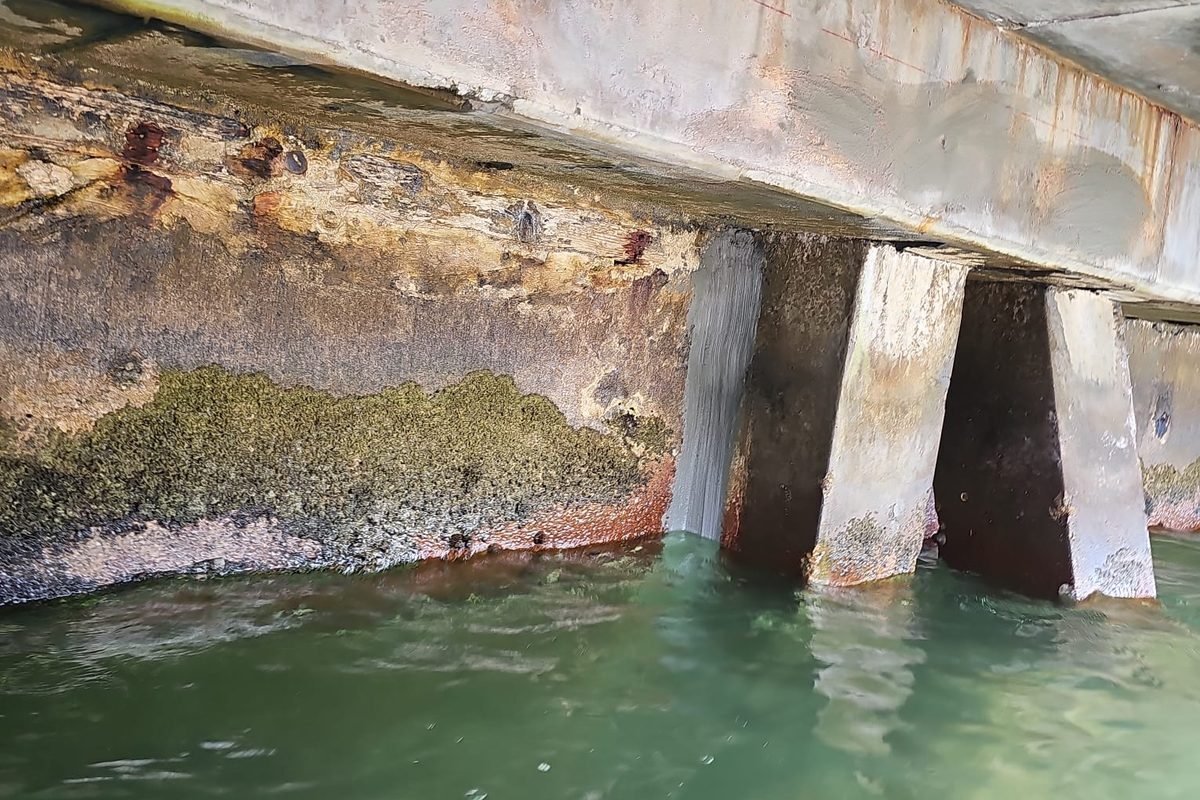
Commercial waterfront property owners in Florida carry seawall liability the moment a wall shows visible distress, whether or not anyone has been hurt yet. Courts and insurers look at what the owner knew and when — a documented inspection history is the single biggest factor in whether a claim, fine, or lawsuit succeeds against you. This guide covers where that liability comes from and how owners limit it.
Key takeaways
- Seawall liability for commercial owners centers on “notice” — did you know or should you have known about the deterioration before an incident occurred.
- Miami-Dade DERM and similar county agencies can issue violation notices for a failing seawall even without an accident, and unresolved violations attach to the property.
- A documented, engineer-sealed inspection is the strongest evidence an owner has both diligence and a defense.
- Commercial seawall inspections are a flat fee, typically $1,500–$3,000 depending on complexity, quoted before the site visit — not priced per linear foot.
- Insurance carriers increasingly require proof of seawall condition before renewing waterfront commercial policies.
What seawall liability actually means for commercial owners
A seawall is a structural retaining element holding back soil, and sometimes a parking lot, walkway, or building foundation, from the water. When it fails, the consequences aren’t limited to the wall itself. Liability can extend to:
- Bodily injury — a collapsed cap, undermined walkway, or sinkhole near the wall injuring a tenant, employee, or visitor.
- Property damage — soil loss undermining a building foundation, parking area, or utility line.
- Environmental violations — erosion or debris entering the waterway, which falls under county and state environmental jurisdiction.
- Neighboring property damage — a failing wall can pull soil and structure from an adjacent parcel, creating a separate claim.
Commercial owners face a higher standard than single-family homeowners because courts generally expect a business operating on waterfront property to maintain it as a professional undertaking, with routine inspection and documentation, not casual observation.
Common liability triggers
Structural failure or partial collapse
Cracked panels, leaning cap beams, and voids behind the wall are the visible warning signs most claims point back to after the fact. A structural seawall inspection identifies these before they become an incident.
Code and permitting violations
Miami-Dade DERM and equivalent Broward and Palm Beach agencies can cite a commercial property for an unpermitted repair, an unmaintained wall, or unauthorized construction near the shoreline. An open violation is a public record tied to the property and typically surfaces during due diligence on a sale or refinance.
Deferred maintenance after a storm
Hurricane season accelerates existing deterioration. An owner who had documented cracking before a storm and did nothing carries more exposure than one who can show a maintenance record and a scheduled repair.
Tenant or lease disputes
Commercial leases on waterfront property often assign maintenance responsibility for shared structures like seawalls, docks, and bulkheads. Ambiguous lease language is a common source of disputes when a wall needs repair and neither party wants to pay.
Insurance and seawall liability
Commercial property and general liability carriers increasingly ask for seawall condition documentation before binding or renewing a policy on waterfront property. An engineer-sealed inspection report is the standard document carriers accept as proof of condition. Without one, owners risk:
- Higher premiums or added exclusions for water-adjacent structural damage.
- Denied claims if the carrier determines the failure stemmed from a long-known, undocumented condition.
- Non-renewal at the policy’s next term.
How Florida law treats seawall maintenance obligations
Florida property owners are generally responsible for maintaining structures on their own land, including seawalls, in a condition that doesn’t create an unreasonable risk to others. Local governments regulate the environmental and permitting side of that obligation — the Florida Department of Environmental Protection and the U.S. Army Corps of Engineers both have jurisdiction over work in or near navigable water, alongside county agencies like DERM. Repair or replacement work also has to meet the structural provisions of the Florida Building Code, including High-Velocity Hurricane Zone requirements for wind-and-water-exposed construction in Miami-Dade and Broward.
None of these agencies conduct routine seawall condition inspections for owners. That responsibility sits with the property owner, which is why a proactive inspection schedule matters more for commercial parcels than the permitting process alone suggests.
Reducing liability exposure
Get a baseline inspection
If your commercial property has never had a documented seawall assessment, that’s the starting point. A commercial property inspection establishes a condition baseline and a written record with a timestamp — the exact document a court or carrier asks for later.
Re-inspect on a schedule, not just after damage
Annual or biennial inspections, timed before hurricane season, catch deterioration while it’s still a repair instead of a failure. Keep every report on file.
Address violations immediately
An open DERM or county violation should never sit unresolved on a commercial parcel. Violation response services handle the engineering, permitting, and documentation needed to close a notice out.
Budget repairs by linear foot, separately from inspection cost
Once an inspection identifies a problem, repair pricing is typically quoted per linear foot of wall — moderate panel or cap repairs generally run $100–$250 per linear foot, and full panel or tieback replacement can reach $400–$600 per linear foot, depending on scope and access. This is different from the inspection itself, which is always a flat fee.
Put maintenance responsibility in writing
For leased commercial waterfront property, confirm in the lease who is responsible for seawall inspection and repair. Ambiguity here is one of the most common and most avoidable sources of disputes.
Talk to a Florida-licensed engineer
Souffront Contractors inspects, engineers, permits, and repairs seawalls under one roof, serving commercial waterfront property in Miami-Dade, Broward, and Palm Beach. A commercial seawall inspection is a flat fee, typically $1,500–$3,000 depending on complexity, quoted before any site visit, with a Florida-licensed structural engineer’s sealed report delivered on the same business day the fieldwork wraps. Use the form below to schedule.
Frequently asked questions
Who is liable if a commercial seawall fails?
Generally the property owner, since Florida law places the maintenance obligation on whoever owns the land the wall sits on. Liability can extend to a tenant if the lease assigns maintenance responsibility to them, but the underlying property owner is still the party most exposed if the lease terms are unclear or unenforced.
Can a commercial property be cited for a seawall violation without an accident?
Yes. Miami-Dade DERM and similar county agencies can issue a violation for visible deterioration, unpermitted repairs, or erosion into the waterway regardless of whether anyone has been injured. The violation becomes a public record tied to the property.
How often should a commercial waterfront property inspect its seawall?
Annually is the general recommendation, ideally before hurricane season, with an additional inspection after any major storm event. Properties with known deterioration or prior repairs may warrant more frequent checks.
Does insurance cover seawall failure on commercial property?
It depends on the policy and the cause. Sudden, accidental failure may be covered, but carriers frequently deny claims tied to long-term, undocumented deterioration. A documented inspection history strengthens a claim and is increasingly required for renewal.
What does a commercial seawall inspection cost?
Typically $1,500–$3,000 as a flat fee, depending on the complexity of the inspection, including whether a below-waterline dive assessment is needed. It’s quoted upfront before any site visit and is never priced by linear foot — that pricing model applies only to repair work.
What’s the difference between seawall inspection and seawall repair costs?
Inspection is a flat fee covering the assessment and engineer-sealed report. Repair is priced per linear foot of wall — moderate repairs generally run $100–$250 per linear foot, with full replacement work reaching $400–$600 per linear foot depending on scope.
Who has jurisdiction over seawall work in Florida?
Multiple agencies can have jurisdiction depending on location and scope: county environmental agencies like Miami-Dade DERM, the Florida Department of Environmental Protection for state waters, and the U.S. Army Corps of Engineers for navigable waterways. Repair and construction work also has to meet Florida Building Code structural requirements.
Does a lease shift seawall liability from owner to tenant?
Only to the extent the lease explicitly assigns maintenance responsibility, and even then the underlying property owner typically retains ultimate liability for third-party injury claims. Clear lease language reduces disputes but doesn’t fully eliminate owner exposure.
About Souffront Contractors Inc.: a Florida-licensed structural engineering and marine construction firm serving Miami-Dade, Broward, and Palm Beach counties. Choose a seawall inspection company whose reports are signed and sealed by a licensed structural engineer — or call (877) 420-7220.
Got a seawall or structural question?
Five fields. Same business day from a Florida-licensed engineer, routed into our dispatch CRM in real time.
- Same business dayAcknowledgment from a Florida licensed engineer — Mon–Fri 8 AM–5:30 PM.
- Engineer-sealed reportAccepted by carriers, building departments, and real-estate transactions.
- Fixed-fee proposalNo hourly billing. Repair scope priced line-by-line.