
What a Seawall Inspection Finds in West Palm Beach
A seawall inspection in West Palm Beach has to account for Lake Worth Lagoon's brackish tides and boat wake. See what engineers find, and what it costs.
A seawall inspection in West Palm Beach has to look at more than cracks in the cap. Lake Worth Lagoon is brackish, tidal, and full of boat traffic, and all three of those things attack a wall differently than open ocean or a quiet canal does. Souffront Contractors inspects walls along this lagoon regularly, and the damage pattern here is consistent enough that we can tell you what we’re going to find before we show up.
Key takeaways
- Lake Worth Lagoon’s brackish, tidal water corrodes steel reinforcement faster than fresh water, which shows up first as rust staining on the cap.
- Boat wake from the Intracoastal Waterway loosens soil behind a wall over years, even when the wall face looks fine.
- A seawall inspection in this market is a flat fee, typically $1,500-$3,000 depending on complexity, quoted before any site visit — never priced by the length of the wall.
- Sandy lagoon-bottom soils behind older walls are prone to voids once a panel or joint opens even slightly.
- Work on or near Lake Worth Lagoon falls under Florida’s submerged-lands and environmental rules, which affects permitting timelines for repairs.
Why Lake Worth Lagoon is harder on a wall than it looks
Lake Worth Lagoon isn’t a freshwater lake. It’s a tidal estuary connected to the Atlantic through the Lake Worth Inlet, so the water along most of West Palm Beach’s waterfront is brackish — a mix of salt and fresh water that moves in and out twice a day. Brackish water carries chloride ions that penetrate concrete and corrode steel reinforcement faster than either pure saltwater or freshwater alone in many exposure conditions. That’s the first thing we look for on a lagoon wall: rust bleeding through the cap or panel face, usually before any crack is visible.
The second factor is traffic. The lagoon carries heavy recreational and commercial boat traffic along the Intracoastal Waterway, and wake action against a seawall is a slow, repetitive load that most owners never think about. Every pass pushes water against the wall and then pulls it back, and over years that cycle works soil loose from behind panels, especially at joints and around older pile caps.
What this means for soil behind the wall
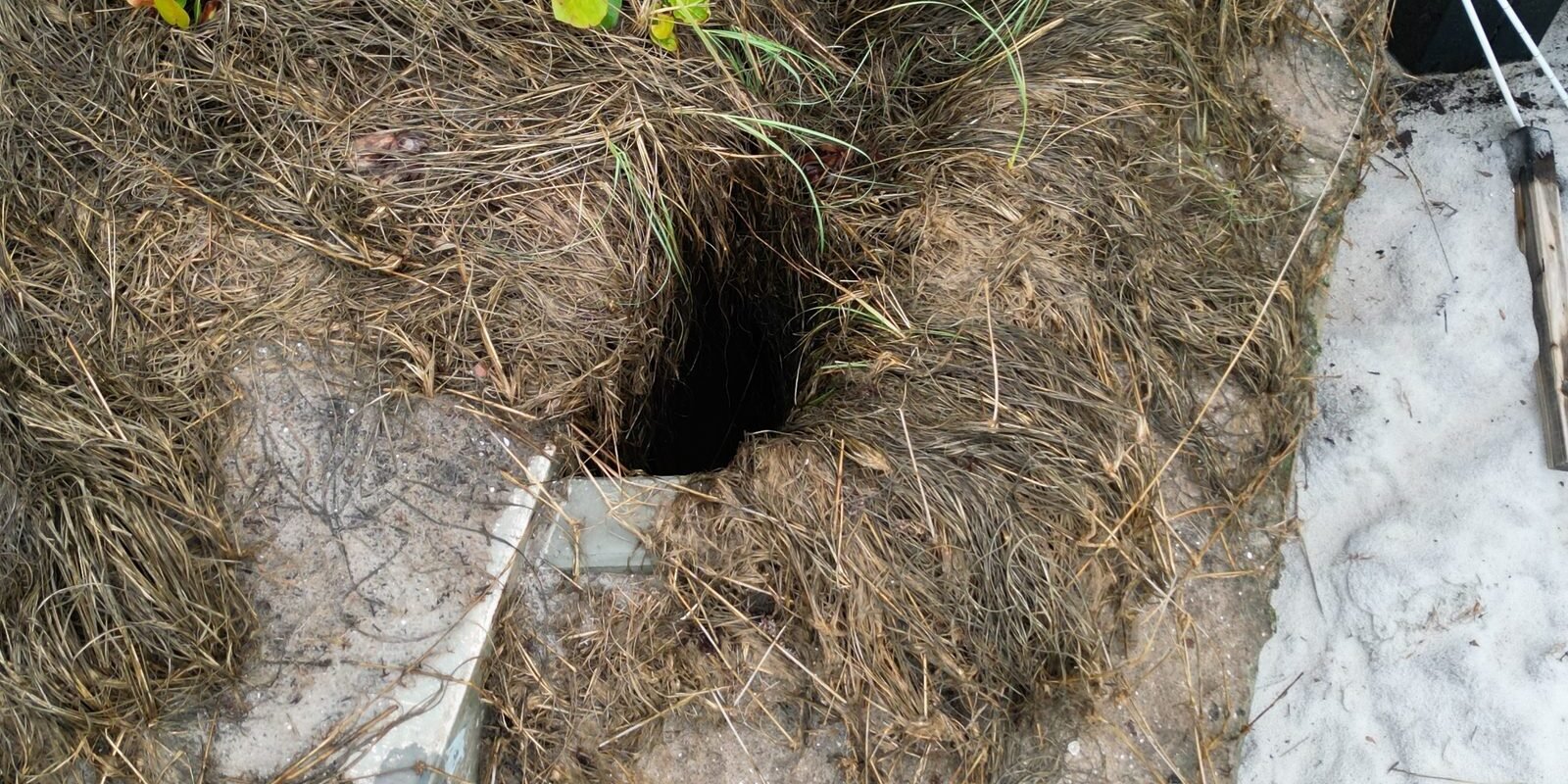
Much of the lagoon shoreline sits on sandy, loosely consolidated fill behind the original seawall. Sand migrates. Once a panel joint opens even a quarter inch, or a weep hole gets blocked and water backs up instead of draining, fine sand starts washing out with every tide cycle. The wall can look structurally sound from the water side for a long time while a void grows behind it — right up until a section of yard or pool deck settles.
What we actually find on a West Palm Beach seawall inspection
Here’s the pattern, from most common to least, on lagoon-front properties we’ve inspected:
- Rust staining on the cap — a reddish-brown bleed line running down the face, almost always tied to rebar corrosion starting inside the concrete.
- Hairline to structural cracking at panel joints — tidal cycling plus boat wake flexes joints that were never designed for constant movement.
- Voids behind the cap or upper panels — detected by sounding the concrete with a hammer; a hollow tone means soil has washed out behind that section.
- Marine growth masking damage below the waterline — barnacles and algae on lagoon walls grow thick enough that a visual-only check from a dock will miss spalling or exposed rebar underneath.
- Leaning or rotated panels near canal mouths and boat lifts — concentrated wake and prop wash at these points accelerates toe erosion.
None of these show up equally on every property. A wall on a quiet finger canal off the lagoon sees far less wake than one facing the open Intracoastal channel near Flagler Drive or the Palm Beach side of the lagoon. Orientation and exposure matter as much as the age of the wall.
Concrete, vinyl, or wood — which holds up in this water
Most West Palm Beach lagoon walls are poured concrete panel-and-cap construction, often 30-50 years old, with steel reinforcement that was never designed with today’s corrosion-resistant coatings. Vinyl sheet pile walls, more common on newer installations, resist chloride penetration completely but can crack or bow under heavy wake loading if the backfill behind them wasn’t compacted correctly. Timber walls are the least common on this stretch of lagoon and the most vulnerable to marine borers in brackish water — we see that damage concentrated below the waterline, where it’s invisible without a dive.
Whatever the material, the inspection has to include a below-waterline check where marine growth or turbidity would otherwise hide the real condition. That’s part of what separates a dock-walk visual check from an actual structural engineer inspection.
What a seawall inspection costs here, and what it doesn’t include
An inspection is a flat fee, quoted before Souffront ever visits the property. For a typical residential lagoon-front wall, that’s $1,500-$3,000, depending on the complexity of the job — access, whether a below-waterline dive is needed, how many structural components the wall has, and the scope of the written report. Wall length is a minor factor in that number, not the basis for it. That’s for the inspection only. If the engineer finds damage that needs repair, that work is priced separately and by the linear foot of wall being fixed — moderate panel or cap repairs generally run $100-$250 per linear foot, and full panel or tieback replacement runs $400-$600 per linear foot. Those are general South Florida ranges, not a quote, and any real number comes after the engineer has seen the wall.
Repairs and new construction on or adjacent to Lake Worth Lagoon also typically require coordination with state environmental rules under the Florida Department of Environmental Protection, since the lagoon is state-owned submerged land. A seawall contractor who hasn’t pulled permits in this specific waterway will underestimate how long that step takes.
Talk to a Florida-licensed engineer
If you own waterfront property on Lake Worth Lagoon and haven’t had the wall looked at in the last few years — or you’ve noticed staining, a lean, or soil settling near the cap — get it checked before it becomes a repair instead of a maintenance item. Souffront Contractors inspects, writes the engineer-sealed report, and if repair is needed, can permit and build it — one company for the whole job, with the inspection fee quoted upfront and a response the same business day. The contact form below gets you scheduled.
Frequently asked questions
How much does a seawall inspection cost in West Palm Beach?
A typical residential seawall inspection runs $1,500-$3,000 as a flat fee, quoted before the engineer visits the site. The price depends on access, whether a below-waterline dive is required, and the number of structural components on the wall — not on the wall’s length.
Why does Lake Worth Lagoon damage seawalls differently than other waterways?
The lagoon is brackish and tidal, so chloride-laden water cycles against the wall twice a day, accelerating corrosion of steel reinforcement inside the concrete. Heavy Intracoastal boat traffic adds constant wake loading that loosens soil behind the wall over years, a mechanism that doesn’t exist on still freshwater canals.
How often should a lagoon-front seawall be inspected?
Most structural engineers recommend a visual check every 1-2 years and a full inspection, including a below-waterline check where needed, every 3-5 years for walls over 20 years old. Older walls, or ones that have already shown staining or cracking, should be checked sooner.
What are the first signs a seawall is failing?
Rust staining bleeding down the cap, visible cracking at panel joints, a hollow sound when the concrete is tapped, soil settling or sinking near the top of the wall, and leaning or rotated panels are the earliest visible signs. Any one of these on its own is worth an inspection.
Do I need a diver for a seawall inspection on the lagoon?
If marine growth or water turbidity hides the wall below the waterline, yes — a visual check from a dock or seawall top will miss spalling or exposed rebar below the surface. An engineer scopes this in before quoting the inspection fee, so it’s included in the flat price, not an add-on later.
Is seawall repair priced the same way as the inspection?
No. The inspection is always a flat fee. If repair is needed afterward, that work is priced per linear foot of wall — generally $100-$250 per linear foot for moderate repairs and $400-$600 per linear foot for full panel or tieback replacement, as general ranges before a specific quote.
Do I need a permit to repair a seawall on Lake Worth Lagoon?
Yes. Because the lagoon is state-owned submerged land, repair or replacement work typically requires coordination with Florida Department of Environmental Protection rules in addition to local building permits. A contractor experienced in this specific waterway should be able to walk you through that timeline before work starts.
What’s the difference between a seawall inspection and just looking at the wall myself?
A homeowner can spot an obvious lean or a big crack, but a structural engineer inspection checks reinforcement condition, taps the concrete to find hidden voids, checks below the waterline, and documents everything in a sealed report that holds up for insurance, sale disclosure, or permitting. That documentation is the part a visual check can’t replace.
Related from Souffront Contractors: seawall repair and dock repair — all delivered by the same Florida-licensed structural engineering and marine construction team. Call (877) 420-7220.
About Souffront Contractors Inc.: a Florida-licensed structural engineering and marine construction firm serving Miami-Dade, Broward, and Palm Beach counties. Learn more about engineer-led seawall repair across South Florida — see our seawall contractors page or call (877) 420-7220.
Got a seawall or structural question?
Five fields. Same business day from a Florida-licensed engineer, routed into our dispatch CRM in real time.
- Same business dayAcknowledgment from a Florida licensed engineer — Mon–Fri 8 AM–5:30 PM.
- Engineer-sealed reportAccepted by carriers, building departments, and real-estate transactions.
- Fixed-fee proposalNo hourly billing. Repair scope priced line-by-line.