
Did Hurricane Season Damage Your Seawall? What to Check Now
Hurricane season is over — here's what a post-storm seawall inspection reveals, what it costs, and why South Florida waterfront owners shouldn't wait.
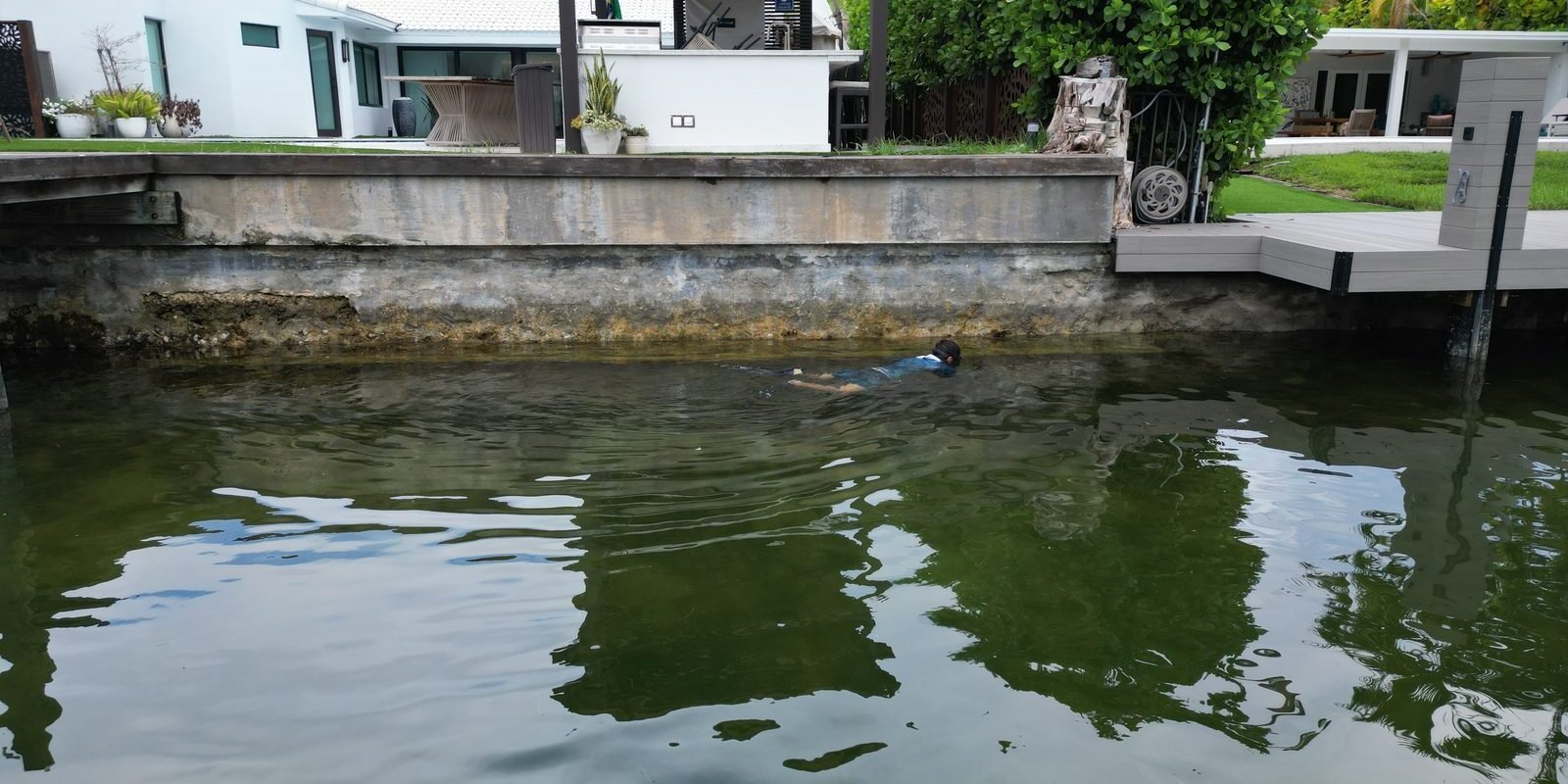
After hurricane season ends, the damage to your seawall may not be obvious from your dock. Storm surge, wave action, and saturated soil move behind the wall where you cannot see them — and a seawall inspection by a Florida-licensed structural engineer is the only reliable way to know what actually happened. Souffront Contractors, serving Miami-Dade, Broward, and Palm Beach counties, schedules post-season inspections at a flat fee — typically $1,500–$3,000 depending on complexity — quoted before anyone visits the site.
Key takeaways
- Hurricane season storm surge and wave loading accelerate seawall deterioration that may not be visible from the surface.
- The highest-risk failure modes — soil loss behind the wall, tieback corrosion, panel rotation — require a trained eye and often an underwater or below-waterline look.
- Post-season inspections in the Biscayne Bay corridor (Coral Gables, Coconut Grove, Key Biscayne, Miami, Miami Beach) are in high demand November through January — schedule early.
- A flat-fee, engineer-sealed inspection report gives condo and HOA boards a defensible record of condition before any repair contractor sets foot on site.
- Moderate seawall repairs typically run $100–$250 per linear foot; full panel or tieback replacement can reach $400–$600 per linear foot — catching damage early usually keeps you in the lower range.
What hurricane season actually does to a seawall
Most waterfront owners think about seawall damage in terms of the obvious: a cracked cap, a panel that has visibly shifted, water pooling on the seawall walk. Those things matter. But the damage that leads to a catastrophic failure — the kind where a section of wall moves suddenly and takes lawn, landscaping, or a dock piling with it — usually starts somewhere you cannot see.
Here is what storm season does behind the scenes:
- Surge loading reverses hydrostatic pressure. Normal conditions push water and soil against the waterside face of the wall. A surge event pushes water over the top and behind the wall, then drains back through any existing crack or joint. That back-and-forth cycles the wall in ways it was never designed for in a single season.
- Wave action erodes the toe. Repeated wave energy removes material from the base of the wall. When the toe loses support, the bottom of the wall can kick out — slowly at first, then faster.
- Saturated soil increases active pressure. After heavy rainfall accompanying a storm, the soil behind the wall becomes heavier. That added weight pushes harder against the panels and tiebacks — the buried anchors that hold the wall against soil pressure. A tieback that was marginal before the season may be at or past its limit by November.
- Saltwater intrusion accelerates corrosion. Surge water carries salt into every crack. Steel tie rods and whalers corrode from the inside. You will not see that from the dock.
In Biscayne Bay communities — Coconut Grove, Key Biscayne, Miami Beach’s Venetian and Sunset Islands, Coral Gables waterfront — tidal range and wave fetch are moderate but persistent. Even a season without a direct hit accumulates loading that shortens a wall’s service life.
What the inspection actually covers — and what it finds
A post-season inspection by a Florida-licensed structural engineer is not a visual walkover. Here is what a thorough inspection includes and what it typically turns up after a busy storm season:
Surface and above-waterline examination
The inspector looks at the cap (the concrete beam at the top of the wall), panel faces, joints between panels, and the connection hardware that ties the cap to the panels. Common findings after hurricane season include horizontal cracking along the cap — a sign the cap has flexed under surge load — spalling concrete where salt has reached the reinforcing steel, and efflorescence (white mineral staining) marking active water migration through cracks.
Below-waterline and toe inspection
Some of the most important findings are below the waterline. Voids behind the wall — gaps where soil has washed out — are invisible from above but detectable by probing and, on more complex walls, an underwater inspection. Toe erosion shows up as a gap between the base of the panel and the bay bottom. If you can see daylight under the wall at low tide, that is a critical finding.
Tieback and anchor assessment
Tiebacks are the buried anchors that hold the wall against soil pressure. A wall without functioning tiebacks is relying entirely on the passive resistance of the panels — which is not enough. The inspector looks for signs of tieback failure: a wall that has rotated slightly at the top, horizontal cracking in the upper third of the panel face, or a cap that has moved toward the water. These are late-stage signs. Early detection requires knowing what to look for before the rotation is obvious.
Drainage and weep holes
Weep holes — small openings through the wall that allow hydrostatic pressure to equalize — frequently clog with debris during storm season. A clogged weep hole means pressure builds behind the wall instead of draining. The inspector checks that weep holes are open and functional.
The engineer-sealed report
The deliverable is an engineer-sealed inspection report that documents condition, identifies deficiencies, prioritizes them by urgency, and gives the owner a clear picture of what needs to happen next. For condo and HOA boards, that report is the defensible record your property manager and legal counsel need before you authorize a single dollar of repair work.
Why boards and property managers should not wait until spring
The post-hurricane inspection window — roughly November through January — fills up fast in South Florida. Every waterfront property in Miami-Dade and Broward is trying to schedule the same thing at the same time. Beyond scheduling, there are three real reasons to move quickly.
- Hidden damage gets worse through winter. Even in South Florida, the cooler, drier months are when a compromised wall can deteriorate quietly. Soil behind a wall with active voids continues to migrate. Corroding steel continues to rust. Waiting until March to inspect damage that occurred in October means three more months of degradation.
- Repair bids require a scope of work. You cannot get comparable bids from seawall repair contractors without a documented scope. A board that goes straight to a contractor for a “free estimate” gets a sales pitch, not an engineering assessment. The engineer’s report comes first.
- Permit timelines are real. Any repair beyond minor patching requires a permit in Miami-Dade and most municipalities. Miami-Dade DERM and local building departments process permits on their schedule, not yours. A project you want completed before next hurricane season needs to start the permit clock before February.
What post-storm repairs actually cost — and when early action saves money
Seawall repair costs in South Florida vary widely based on what the inspection finds. Here are realistic industry ranges to frame the decision:
- Crack injection, cap repair, weep-hole clearing: These are moderate repairs — typically in the $100–$250 per linear foot range depending on scope.
- Tieback replacement or new tieback installation, panel replacement, toe armor: These are structural repairs and can run $400–$600 per linear foot or more for full replacement.
- Emergency stabilization after a section has moved or failed: costs escalate quickly and typically require expedited permitting, mobilization charges, and emergency engineering fees on top of construction costs.
The pattern is consistent: boards that inspect annually and catch damage early stay in the moderate-repair range. Boards that defer inspection until something visible fails tend to pay for the structural work they avoided plus the emergency response on top of it.
These are general industry ranges — not a Souffront quote. Every project is different. What matters is that the repair scope comes from an engineering inspection, not from a contractor’s unaided estimate.
When the board needs more than just an inspection — engineer-led oversight from scope through closeout
For some condo and HOA boards, the inspection report is the beginning of a larger problem: a wall that needs significant repair, a board made up of volunteers with no construction background, and a contractor who answers only to himself.
This is exactly the scenario where engineer-led construction management — also called owner’s representative work — protects the board. The construction manager is the board’s single point of contact from the moment the scope is written through final closeout. Concretely, that means:
- Writing a bid-ready scope of work so competing bids from seawall contractors are actually comparable — apples to apples, not the low bid that left out the tiebacks.
- Reviewing submittals and shop drawings to verify the contractor’s materials match what was specified.
- Being on site at the milestones that matter — tieback installation, cap pour, backfill — because those are the moments where shortcuts happen and there is no going back.
- Reviewing pay applications to confirm work billed is work completed.
- Evaluating change orders: is this a real differing condition the contractor encountered, or a bid gap the board is now being asked to fund?
- Managing permit and agency coordination — DERM, the city building department, Florida DEP where coastal work triggers their jurisdiction.
- Delivering closeout documentation: as-builts, warranties, and a final package the next board can actually use.
One important disclosure: Souffront both provides construction management oversight and performs marine construction work. If a board engages Souffront as their owner’s representative and Souffront has any interest in bidding the repair work, that is disclosed in writing before the engagement starts. A board can also hire Souffront for oversight only, with the construction awarded to a separate contractor. Either way, the arrangement is transparent up front — that is the only way it works.
Souffront’s edge here is genuine: the person overseeing the project has actually built this type of work. A Florida-licensed structural engineer who has poured seawall caps and installed tiebacks reads a shop drawing differently than one who has only reviewed them.
Talk to a Florida-licensed structural engineer
If your waterfront property in Coral Gables, Key Biscayne, Coconut Grove, Miami Beach, or anywhere along the Biscayne Bay corridor came through hurricane season without a professional inspection, now is the time to schedule one. Souffront Contractors offers flat-fee, engineer-sealed post-season seawall inspections — quoted upfront before any site visit, with same-business-day response on inquiries. Call (877) 420-7220 or fill out the form below to get a quote for your property.
Frequently asked questions
How much does a post-hurricane seawall inspection cost in South Florida?
A flat-fee seawall inspection by a Florida-licensed structural engineer typically runs $1,500–$3,000 in South Florida, depending on the complexity of the inspection — factors include the number of structural components, whether an underwater or below-waterline assessment is needed, access conditions, and report scope. The fee is quoted upfront before anyone visits the site. It is not priced per linear foot.
What is the difference between a visual walkover and an engineering inspection?
A visual walkover is a surface-level observation — anyone can do it. An engineering inspection involves a Florida-licensed structural engineer assessing above-waterline and below-waterline conditions, probing for voids behind the wall, evaluating tieback performance indicators, reviewing drainage, and producing a sealed report with prioritized findings. The sealed report is what a board, insurance carrier, or future buyer can rely on.
My seawall looks fine after the storm. Do I still need an inspection?
Yes. The most dangerous seawall conditions — soil voids behind the wall, corroding tiebacks, toe erosion — are invisible from the surface. A wall that looks intact from your dock can have significant structural deficiencies. Storm surge and wave loading operate below the waterline and behind the face of the wall, where surface observation misses them entirely.
How soon after hurricane season should I schedule a seawall inspection?
As soon as possible after the season ends — ideally November or December. Post-season scheduling fills quickly across South Florida’s waterfront communities. Waiting until spring also means months of additional degradation if damage is present, and it compresses the time available to permit and complete repairs before the next season begins in June.
What happens if the inspection finds damage? How do repairs get permitted in Miami-Dade?
The inspection report documents the deficiencies and recommended repairs. Any structural seawall repair beyond minor patching requires a permit — in Miami-Dade that typically means coordination with Miami-Dade DERM and the local building department, and may involve Florida DEP for coastal or navigable-water work. The permit process takes time, which is another reason to inspect early and start the clock before February if you want repairs completed before the next hurricane season.
Can a condo or HOA board use the same firm for both the inspection and the repair?
Yes, and many do — with an important caveat. The inspection should produce an objective, engineer-sealed finding of condition, independent of any repair interest. At Souffront, if the inspecting engineer’s firm has any interest in bidding the subsequent repair work, that is disclosed in writing before the inspection engagement begins. A board can also choose to use the inspection report to solicit competitive bids from separate seawall repair contractors, using the report as the scope of work.
What is an owner’s representative on a seawall repair project, and does my HOA need one?
An owner’s representative — sometimes called a construction manager or the board’s engineer — is the person hired by the board to oversee the contractor on the board’s behalf. They write the bid documents, review submittals, observe construction at critical milestones, check pay applications, and evaluate change orders. Most HOA and condo boards are made up of volunteers without construction backgrounds; an owner’s representative is how a board avoids approving a $180,000 change order with no way to know whether it is legitimate. Whether you need one depends on project size and complexity — it is worth asking about before the contractor is already under contract.
Which South Florida cities does Souffront serve for post-hurricane seawall inspections?
Souffront serves waterfront properties throughout Miami-Dade, Broward, and Palm Beach counties — including Coral Gables, Coconut Grove, Key Biscayne, Miami, Miami Beach (including the Venetian Islands, Sunset Islands, and North Beach), Aventura, Sunny Isles Beach, North Miami, Fort Lauderdale, Hollywood, Pompano Beach, Boca Raton, and Palm Beach. Call (877) 420-7220 to confirm scheduling availability in your area.
Related from Souffront Contractors: HOA and condo board compliance reports — all delivered by the same Florida-licensed structural engineering and marine construction team. Call (877) 420-7220.
About Souffront Contractors Inc.: a Florida-licensed structural engineering and marine construction firm serving Miami-Dade, Broward, and Palm Beach counties. Book a seawall inspection in Miami or anywhere on the South Florida waterfront — see our seawall contractors page or call (877) 420-7220.
Got a seawall or structural question?
Five fields. Same business day from a Florida-licensed engineer, routed into our dispatch CRM in real time.
- Same business dayAcknowledgment from a Florida licensed engineer — Mon–Fri 8 AM–5:30 PM.
- Engineer-sealed reportAccepted by carriers, building departments, and real-estate transactions.
- Fixed-fee proposalNo hourly billing. Repair scope priced line-by-line.