
Can Your Seawall Support a Boat Lift Installation?
Before boat lift installation, your seawall needs a load check. What a Coral Gables field engineer looks for in the cap, panels, and piles first.
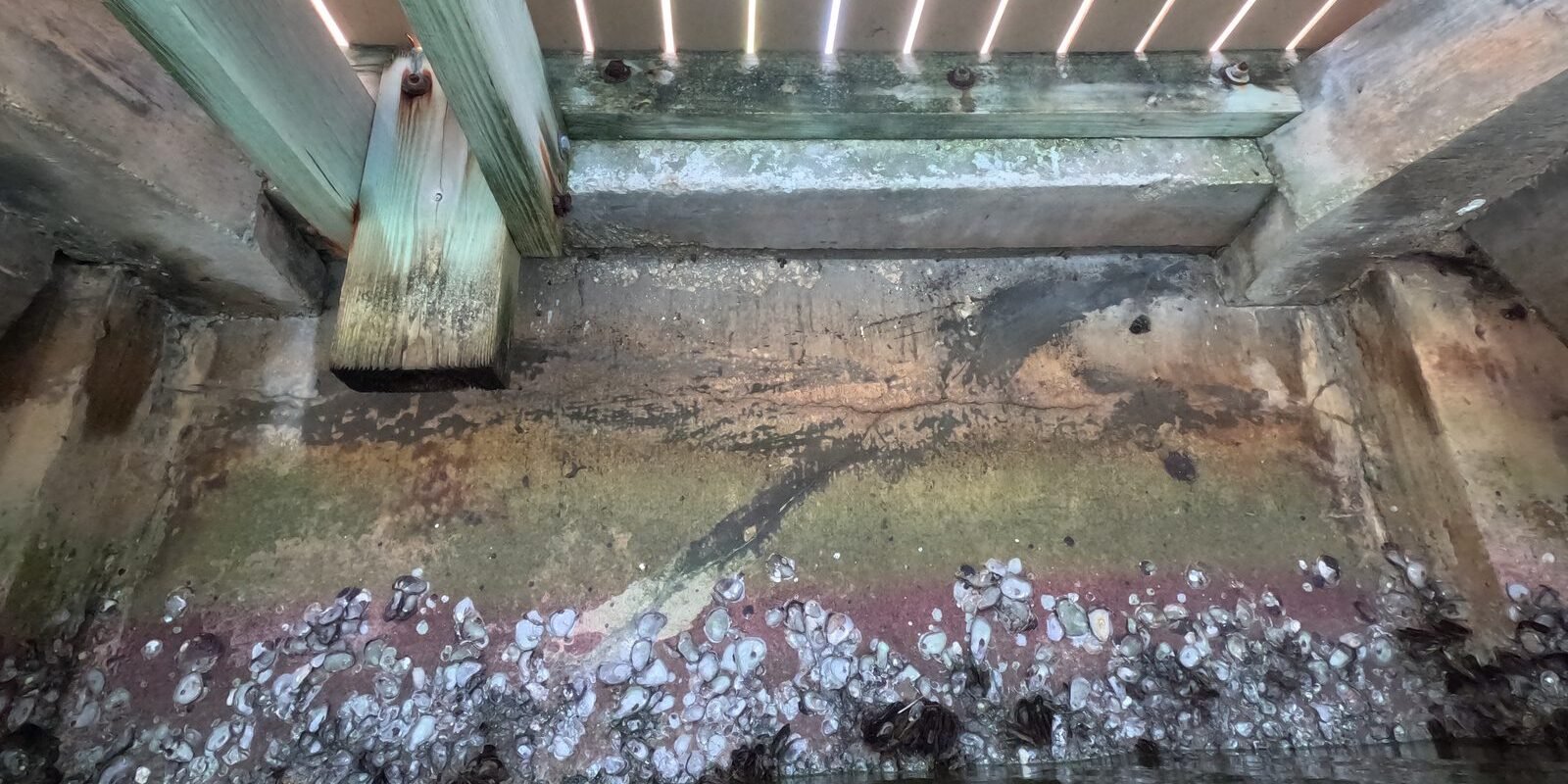
Stand on a dock in Coral Gables while a crew sets a new boat lift, and you can watch the mistake happen in real time: the davit posts get bolted straight into a cap that’s already hairline-cracked, with nobody checking what’s behind it. Souffront Contractors gets called out after the fact more than we’d like — a leaning lift, a cap that spalled around the anchor bolts, a wall that never had the reserve strength for the load in the first place. Boat lift installation adds real, concentrated weight to a structure built to hold back soil and water, not carry a boat. Before you sign a lift contract, the seawall itself needs to be checked.
Key takeaways
- A boat lift transfers hundreds to several thousand pounds of point-load onto the seawall cap and the panel or piles behind it — not a distributed load like the wall was designed for.
- A structural engineer inspection before installation typically runs $1,500–$3,000, flat fee, quoted before any site visit — not priced by wall length.
- Cracks radiating from old anchor bolts, a cap that flexes underfoot, or voids behind the panel are the three most common reasons Souffront rejects a mounting location.
- Piling-mounted lifts (freestanding posts driven into the substrate) put little to no load on the seawall itself and are often the safer call on an older wall.
- Miami-Dade DERM and most city building departments require a permit for boat lift installation on tidal waterways, and a sealed engineering letter speeds that review.
What boat lift installation actually asks of an old seawall
A seawall is engineered to resist lateral soil pressure — the ground behind it pushing outward toward the water. It is not engineered to be a foundation. When a boat lift is bolted directly to the cap, the load path changes. Instead of pressure spread evenly along the wall, you get four to six concentrated anchor points carrying the static weight of the lift plus the dynamic weight of the boat as it’s raised and lowered, plus wind and wave loading on a boat sitting up out of the water.
On a seawall in good condition, with a solid cap and intact panels, that added load is usually manageable. On a wall with existing deterioration — and in canal-front neighborhoods like Coral Gables and Miami Beach, a lot of the seawall stock is 30, 40, even 60 years old — the lift becomes the thing that finally overloads a wall that was already close to its limit.
The load path: cap, panel, piles, backfill
When we inspect a wall for boat lift installation, we’re tracing the load all the way down, not just looking at the cap:
- Cap — the horizontal concrete beam the lift usually bolts to. We check for cracking, exposed or rusted rebar, and whether the cap is monolithic with the wall or a separate pour that’s come loose.
- Panels — the vertical face of the wall. Bowing, rotation, or spalling here means the wall is already under more soil pressure than it should be, before you add anything on top.
- Piles — on pile-supported walls, the king and batter piles that anchor the whole system into the substrate. A boat lift that ties into a panel with failing piles behind it is tying into nothing.
- Backfill and soil — voids behind the wall from soil loss show up as a hollow sound on the cap or visible settlement in the yard above it. A void changes the whole calculation.
A bulkhead wall (no king or batter piles, tieback-anchored) gets checked differently — the tiebacks and their anchorage take priority over the pile question.
Field signs a wall isn’t ready for a lift yet
You don’t need an engineering degree to spot the early warnings. On site, we look for:
- Cracks that radiate outward from existing bolts, brackets, or old lift hardware — a sign the cap has already been overloaded once.
- A cap that flexes or sounds hollow when you walk it, especially near the proposed mounting location.
- Rust staining bleeding through the concrete — corroding rebar expanding and cracking the cap or panel from the inside.
- Visible gaps, tilting, or a wall that’s rotated even slightly out of plumb.
- Standing water or soft, settled soil directly behind the wall after rain — a sign of soil loss through joints or voids.
Any one of these doesn’t automatically disqualify the wall, but it changes where — or whether — a lift gets mounted to it.
Get a structural engineer inspection before you sign the lift contract
The order of operations matters. Most boat lift companies will sell and install a lift without ever asking whether the seawall can carry it — that’s not their scope, and it’s not their liability if it fails. A seawall inspection from a Florida-licensed structural engineer, done before the lift order goes in, tells you three things: whether the wall can take the load as-is, where the anchor points should go if it can, and what repair — if any — needs to happen first.
For a residential wall, that inspection is a flat fee, typically $1,500–$3,000 depending on complexity — access, whether a below-waterline dive is needed, and how many structural components are assessed — quoted upfront before any site visit, never priced per linear foot of wall. The output is a sealed report you hand to the lift installer and, if needed, to the permitting department.
Cantilever, elevator, and piling-mounted lifts: not the same load
Not every lift style puts the same demand on a seawall:
- Cantilever and hydraulic lifts bolted to the cap put the full point-load directly on the wall. These need the strongest verification before install.
- Elevator-style lifts on their own pilings driven independently of the seawall carry their own weight into the substrate, not into the wall. This is usually the lower-risk option on an older or marginal wall.
- Davit installation for smaller boats and personal watercraft is lighter-duty but still concentrates load at two or four points — worth the same cap check even though the total weight is lower.
On a wall we’ve flagged as borderline, moving the lift to independent pilings instead of the cap is often the fix that avoids a much larger seawall repair bill.
Permitting for a lift on a seawall in Miami-Dade and Broward
Boat lift installation on tidal water generally requires a permit from the city or county building department, and in many cases a review by Miami-Dade DERM for anything touching the shoreline or submerged land. A sealed engineering letter confirming the wall’s capacity — or documenting the repair completed before installation — is often what gets a permit application through review without a stop-work order later. Projects that don’t meet the Florida Building Code’s coastal construction requirements get flagged during inspection, not before, which costs more to fix once the lift is already installed.
What it costs to reinforce a seawall before a lift goes on
If the inspection finds the wall isn’t ready, the fix is usually localized, not a full wall replacement. Cap repair or a reinforced pad to spread the lift’s load runs on the lower end of typical seawall repair pricing — general South Florida ranges run roughly $100–$250 per linear foot for moderate repair work, and $400–$600 per linear foot where full panel or tieback replacement is needed. A boat lift usually only needs the section under and immediately around the mounting points addressed, which keeps the repair well short of a full-wall number in most cases.
Talk to a Florida-licensed engineer
If you’re planning boat lift installation on a canal or bay-front seawall anywhere from Coral Gables to Miami Beach, get the wall checked before the lift order goes in. Souffront inspects, engineers, permits, and builds under one roof, so the same firm that tells you whether the wall can take the load can also do the repair if it can’t — one fixed-fee report, same-business-day response, no separate contractor to coordinate. The inspection request form is below.
Frequently asked questions
Can any seawall support a boat lift?
Not automatically. A seawall is built to resist soil and water pressure, not to act as a foundation for concentrated point-loads. Whether a specific wall can carry a lift depends on the condition of the cap, panels, and piles or tiebacks behind it — which is why a structural engineer inspection comes before, not after, the lift is ordered.
How much weight does a boat lift add to a seawall?
It varies by lift type and boat size, but a cap-mounted lift concentrates the combined static and dynamic load — lift hardware, boat weight, and wave or wind loading while the boat is raised — into just four to six anchor points, rather than spreading it along the wall the way soil pressure normally does.
Do I need a structural engineer inspection before installing a boat lift?
It’s strongly recommended and often required by permitting departments. A Florida-licensed structural engineer inspection confirms whether the wall can take the load, identifies the best anchor location, and documents any repair needed first — typically $1,500–$3,000 flat fee, quoted before the site visit.
What’s the difference between a piling-mounted and cantilever boat lift?
A cantilever or hydraulic lift bolts directly to the seawall cap and transfers its full load into the wall. A piling-mounted or elevator-style lift is driven on its own independent pilings, carrying its weight into the substrate instead of the seawall — often the better choice on an older or marginal wall.
Do I need a permit for boat lift installation in Miami-Dade or Broward?
Yes, in most cases. Boat lift installation on tidal water typically requires a city or county building permit, and projects touching the shoreline or submerged land often need Miami-Dade DERM review. A sealed engineering letter confirming the wall’s capacity speeds that process.
What are the warning signs my seawall isn’t ready for a lift?
Cracks radiating from old bolt holes, a cap that flexes or sounds hollow when walked, rust staining bleeding through concrete, visible tilt or rotation in the wall, and soft or settled soil behind the wall after rain are the most common field indicators of a wall that needs attention before a lift goes on.
How much does it cost to reinforce a seawall for a boat lift?
Most lift-related reinforcement is localized to the mounting area rather than the full wall. General South Florida seawall repair ranges run roughly $100–$250 per linear foot for moderate repairs and $400–$600 per linear foot for full panel or tieback replacement, with a lift mount usually needing only the affected section addressed.
Should a boat lift be anchored to the seawall or to separate pilings?
On a wall confirmed in good structural condition, cap-mounting is common. On a wall with any deterioration, independent pilings driven separately from the seawall are often the safer and less expensive path, since they carry the lift’s load into the substrate instead of adding it to an already-stressed wall.
Related from Souffront Contractors: dock repair and seawall design — all delivered by the same Florida-licensed structural engineering and marine construction team. Call (877) 420-7220.
About Souffront Contractors Inc.: a Florida-licensed structural engineering and marine construction firm serving Miami-Dade, Broward, and Palm Beach counties. Partner with a full-service marine construction company for docks, seawalls, and waterfront structures — see our seawall contractors page or call (877) 420-7220.
Got a seawall or structural question?
Five fields. Same business day from a Florida-licensed engineer, routed into our dispatch CRM in real time.
- Same business dayAcknowledgment from a Florida licensed engineer — Mon–Fri 8 AM–5:30 PM.
- Engineer-sealed reportAccepted by carriers, building departments, and real-estate transactions.
- Fixed-fee proposalNo hourly billing. Repair scope priced line-by-line.