
How Boat Wake Erodes a Seawall Toe in Coconut Grove
Boat wake and prop wash scour the soil under a seawall footing over time. Learn the warning signs, what causes toe erosion, and when to call a structural engineer.
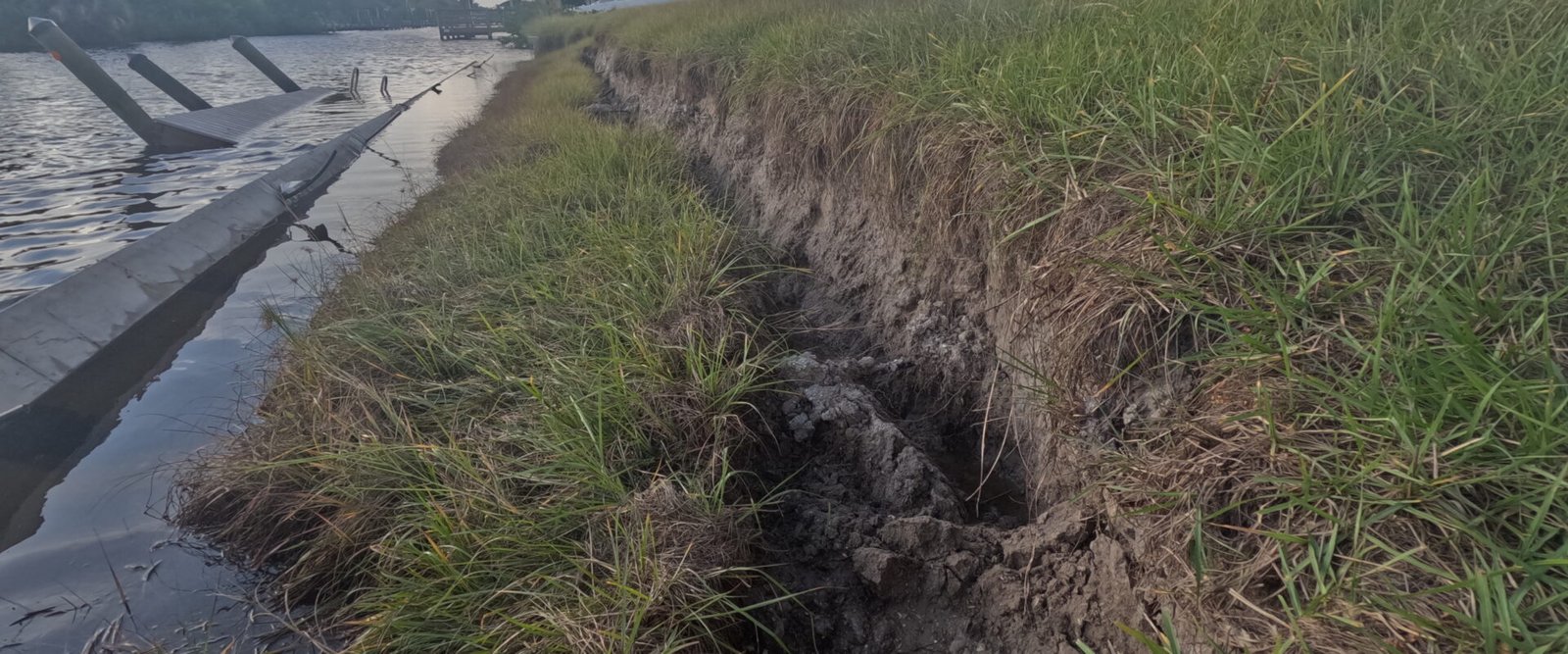
Boat wake and prop wash erode a seawall toe by repeatedly washing soil out from under the wall’s footing, a process called scour. Over months and years this creates a void behind and below the panel, and the wall eventually loses the support it needs to stay upright. Along canal-front and Biscayne Bay properties in Coconut Grove, Coral Gables, and Key Biscayne, this is one of the most common reasons a seawall that looked fine last year is leaning this year. Souffront Contractors sees toe erosion on nearly every canal-front property we inspect near active boat traffic.
Key takeaways
- Toe erosion is the loss of soil at the base (toe) of a seawall, caused by repeated wave and current action from boat wake and prop wash.
- Idle-speed and manatee zones reduce wake energy but do not eliminate scour — wake still reaches the wall at an angle, and prop wash from thrusters and outboards works close to the toe even at low speed.
- Warning signs include soil settlement or a sinkhole behind the cap, a hollow sound when tapping the panel near the waterline, and visible undercutting at low tide.
- A structural engineer assesses toe condition with a visual and, where needed, an underwater review, then documents findings in a sealed report.
- Toe scour repairs typically run $100–$250 per linear foot for moderate work and $400–$600 per linear foot for full panel and tieback replacement, depending on wall type and access.
What toe erosion actually is
Every seawall panel rests on a footing set into the canal or bay bottom. The toe is that buried base — the point where the wall meets the seabed. Soil pressure from the yard side pushes against the wall; the toe and any embedment depth resist that pressure. When water repeatedly moves soil away from the toe, the wall loses that resistance without any visible change above the waterline.
Wake and prop wash are two different mechanisms working together. Wake is the surface wave a passing boat generates, which breaks against the wall and pulls sediment back out with it on the return. Prop wash is the direct thrust from an engine or thruster, which can scour the bottom in a tight, concentrated jet — common near docks, boat lifts, and tight canal turns where boaters gun the throttle to maneuver.
Why it’s worse on narrow canals
A narrow canal reflects wake energy off both sides instead of letting it dissipate, so the same boat produces more repeated wave action per linear foot of seawall than it would on open water. Properties on canal bends, near marina entrances, or across from a public boat ramp see the highest cumulative scour.
Warning signs a property owner can check
- Soil settlement or depressions in the yard within a few feet of the cap — soil is migrating down into a void created by toe scour.
- A hollow or drummy sound when tapping the panel near the waterline, indicating the panel has lost backing behind it.
- Visible undercutting at low tide — a gap or overhang where the toe should meet the bottom.
- Cracking or stepping at panel joints, which often shows up months after the scour itself started.
- A cap that has begun to tilt waterward, even slightly — this is a late-stage sign, not an early one.
None of these signs tell you how far the damage has progressed on their own. A seawall inspection pairs a visual walk of the cap and panels with, where warranted, a below-waterline review to check the toe directly.
Regulatory context: idle speed doesn’t mean zero wake
Miami-Dade County and many municipalities post idle-speed or manatee zones on canals with heavy seawall frontage, and these zones measurably reduce wake height. They do not eliminate wake or prop wash. A boat at idle still displaces water, and a boat maneuvering into a slip or lift at low speed can direct significant prop wash straight at an adjacent toe. Owners considering permitted repair work — riprap, toe protection, or panel replacement — typically need to coordinate with Miami-Dade DERM and, where the work touches navigable water, the U.S. Army Corps of Engineers Jacksonville District.
What a structural engineer looks for
An inspection focused on wake and prop wash damage looks past the cap and checks the parts of the wall that actually resist scour:
- Toe embedment depth compared to the design or as-built depth, where available
- Voids or soil loss behind the panel, checked by sounding or probing at intervals along the wall
- Panel deflection or bowing, which indicates the wall is already working harder to hold soil that used to be supported by the toe
- Condition of tiebacks and deadmen, since a compromised toe shifts more load onto the anchor system
- Marine growth patterns that can mask an undercut toe from a surface look alone
A structural inspection is priced as a flat fee, typically $1,500 to $3,000 depending on the complexity of the property and whether a below-waterline dive is needed, and it is quoted before any site visit. The result is a sealed report from a Florida-licensed structural engineer that documents toe condition, assigns a severity rating, and lays out what repair — if any — is warranted and on what timeline.
Repair options once toe erosion is confirmed
The right fix depends on how much soil has been lost and whether the panel or footing itself has been compromised:
- Toe scour protection — placing riprap, articulated concrete mat, or a toe apron to break up wave and prop wash energy before it reaches the wall. Often the most cost-effective fix when caught early.
- Grouting or soil injection — filling voids behind the panel to restore lost support without full replacement.
- Panel and tieback replacement — required once a panel has deflected, cracked structurally, or lost enough toe support that patching won’t hold.
Repair costs run roughly $100–$250 per linear foot for moderate toe protection and grouting work, and $400–$600 per linear foot for full panel and tieback replacement — figures that vary with wall type, access, and permitting. These are seawall repair costs specifically, separate from the inspection fee that identifies the problem in the first place.
Talk to a Florida-licensed engineer
If a canal-front or bay-front property shows settlement, a hollow-sounding panel, or visible undercutting at low tide, don’t wait for a lean to confirm it. Souffront Contractors is a Florida-licensed structural engineering and marine construction firm serving Miami-Dade, Broward, and Palm Beach — one company that inspects the wall, engineers the fix, pulls the permit, and builds the repair. Every inspection is quoted as a flat fee before we schedule the visit, and the sealed report is typically ready the same week. Call (877) 420-7220 or use the form below to schedule.
Frequently asked questions
Can boat wake really damage a seawall that looks fine above the waterline?
Yes. Toe erosion happens at and below the waterline, where soil is scoured out from under the footing. A wall can look straight and intact from the yard for a year or more while losing the support that keeps it that way, which is why a below-waterline check matters on properties with regular boat traffic.
What’s the difference between boat wake and prop wash damage?
Wake is the surface wave a passing boat creates, which repeatedly washes against the wall and pulls sediment back with it. Prop wash is the direct thrust from an engine or thruster, which scours the bottom in a concentrated jet — most damaging near docks, lifts, and tight turns where boats maneuver at close range.
Do idle-speed zones prevent seawall erosion?
They reduce it but don’t stop it. Idle-speed and manatee zones lower wake height, but boats still displace water at idle, and prop wash from low-speed maneuvering near a dock or lift can still scour a nearby toe over time.
How do I know if my seawall’s toe has already eroded?
Look for soil settlement or small depressions in the yard near the cap, a hollow sound when tapping the panel near the waterline, or visible undercutting at low tide. Any of these warrants a structural inspection to check the toe condition directly.
How much does fixing toe erosion cost?
Toe protection and grouting to restore lost support typically run $100–$250 per linear foot. Full panel and tieback replacement, needed once the panel itself has been compromised, typically runs $400–$600 per linear foot. Actual cost depends on wall type, access, and permitting.
How often should a canal-front seawall be inspected for wake damage?
Properties on high-traffic canals, near marina entrances, or on canal bends should be checked every two to three years, or sooner after a season of unusually heavy boat traffic or a named storm. Lower-traffic locations can typically go longer between checks.
Does Souffront Contractors handle both the inspection and the repair?
Yes. Souffront inspects the wall, engineers the repair, permits the work through Miami-Dade DERM and local building departments, and builds it — one company for the full scope, from the sealed report through construction.
Is prop wash damage covered by homeowners insurance?
Coverage varies by policy and cause of loss, and gradual erosion is often treated differently than sudden storm damage. Property owners should check their specific policy language and talk to their insurer directly; a sealed engineering report documenting the cause and extent of damage is often required to support a claim either way.
Related from Souffront Contractors: engineer-sealed reports, foundation repair and dock repair — all delivered by the same Florida-licensed structural engineering and marine construction team. Call (877) 420-7220.
About Souffront Contractors Inc.: a Florida-licensed structural engineering and marine construction firm serving Miami-Dade, Broward, and Palm Beach counties. Reach a licensed seawall contractor in Boca Raton and across Palm Beach County — see our seawall contractors page or call (877) 420-7220.
Got a seawall or structural question?
Five fields. Same business day from a Florida-licensed engineer, routed into our dispatch CRM in real time.
- Same business dayAcknowledgment from a Florida licensed engineer — Mon–Fri 8 AM–5:30 PM.
- Engineer-sealed reportAccepted by carriers, building departments, and real-estate transactions.
- Fixed-fee proposalNo hourly billing. Repair scope priced line-by-line.