
Cathodic Protection for Seawalls & Rebar Corrosion
How cathodic protection stops rebar corrosion in marine concrete seawalls, what causes it, warning signs to watch for, and repair options in South Florida.
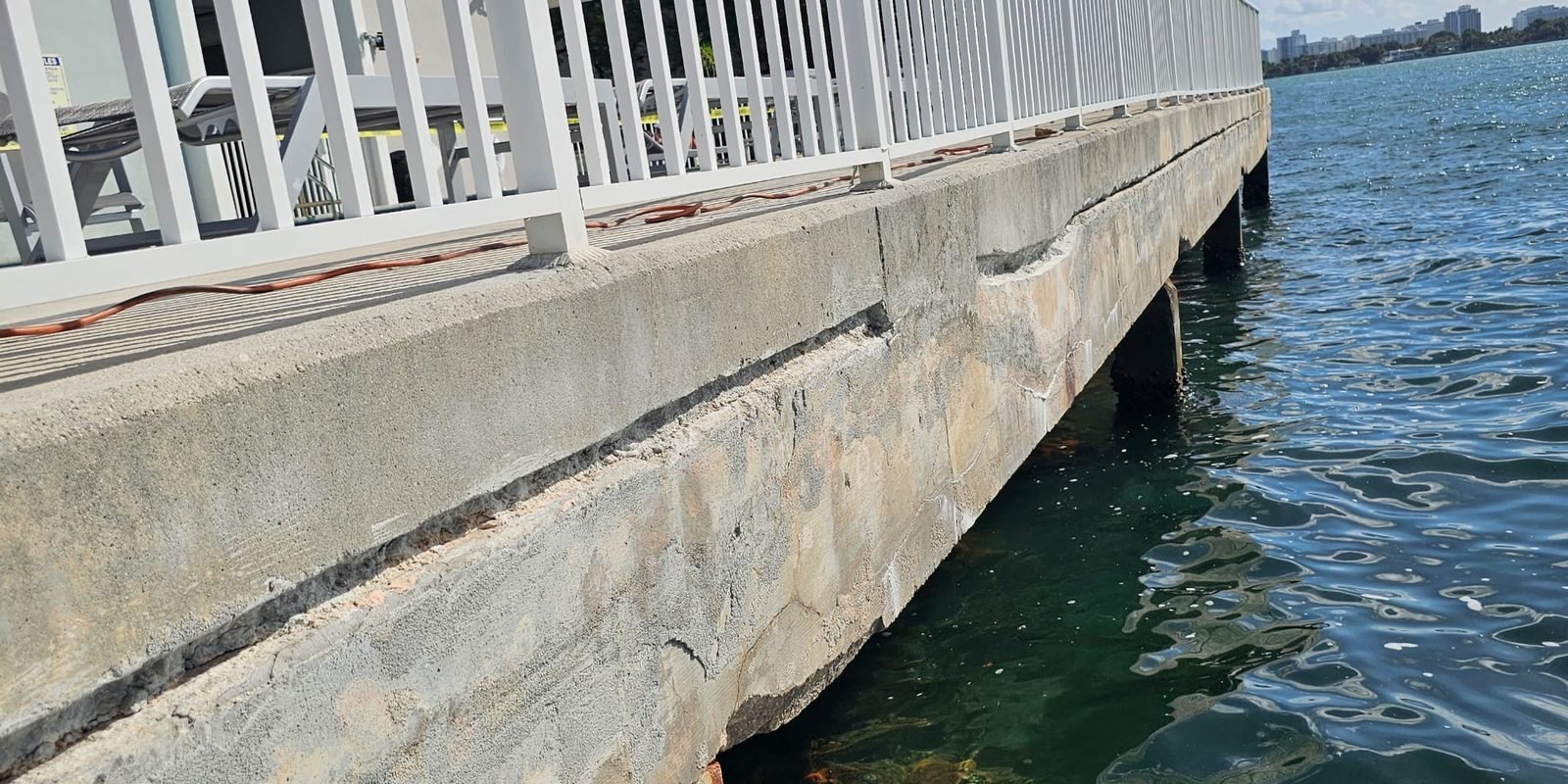
Cathodic protection for seawalls is an engineering method that stops or slows rebar corrosion inside marine concrete by using a sacrificial metal or a controlled electrical current to redirect the corrosion process away from the structure’s steel reinforcement. It is one of the few repair strategies that addresses the root cause of concrete deterioration — chloride-driven steel corrosion — instead of only patching the visible damage. In South Florida’s saltwater environment, it is increasingly used on seawalls, docks, and pilings where rebar corrosion has already started or is likely to start soon.
Key takeaways
- Rebar corrosion in marine concrete is caused by chloride ions from saltwater reaching the embedded steel and breaking down its protective oxide layer.
- Corroding steel expands to roughly two to four times its original volume, which cracks and spalls the surrounding concrete from the inside out.
- Cathodic protection uses either sacrificial anodes (zinc, aluminum, or magnesium) or an impressed current system to stop the electrochemical reaction that causes corrosion.
- Cathodic protection works best as a proactive or early-stage measure — once concrete has spalled significantly, panel or section replacement is usually more practical.
- A Florida-licensed structural engineer should assess chloride content, rebar condition, and structural section loss before recommending cathodic protection versus traditional repair.
What causes rebar corrosion in marine concrete
Reinforced concrete relies on the steel rebar inside it for tensile strength, while the surrounding concrete provides an alkaline environment that naturally protects the steel from rust. In a marine setting, that protection breaks down over time. Saltwater and salt-laden air carry chloride ions into the concrete through cracks, pores, and construction joints. Once enough chloride reaches the rebar, it destroys the steel’s protective oxide layer and corrosion begins.
The corrosion byproduct — iron oxide — occupies far more space than the original steel. As it expands, it pushes outward against the surrounding concrete, creating internal pressure that eventually cracks and delaminates the material. This is why seawall damage often looks worse than it initially seems: by the time rust staining or spalling is visible on the surface, corrosion has usually been active below the surface for months or years.
Common chloride entry points on a seawall
- Hairline cracks from thermal movement or original construction
- Construction joints and cold joints between concrete pours
- Areas with reduced concrete cover over the rebar
- Splash and tidal zones, where wetting and drying cycles concentrate chlorides
- Voids or honeycombing from the original placement of the concrete
What cathodic protection actually does
Cathodic protection does not remove chloride from the concrete. Instead, it changes the electrochemical conditions around the rebar so the steel stops acting as the anode — the part of the corrosion cell that loses metal. There are two main approaches used on marine and coastal structures.
Sacrificial (galvanic) anode systems
A more reactive metal, typically zinc, aluminum, or magnesium, is attached to or embedded near the rebar. Because this metal corrodes more easily than steel, it corrodes preferentially and “sacrifices” itself, protecting the rebar in the process. Galvanic anodes require no external power source, which makes them well suited to seawalls, docks, and other structures where running electrical service is impractical.
Impressed current cathodic protection (ICCP)
ICCP systems use an external power source and inert anodes to apply a small, continuous electrical current that counteracts the corrosion reaction. ICCP offers more control and can protect larger or more heavily corroded structures, but it requires a power connection, monitoring equipment, and ongoing maintenance — making it more common on larger commercial marine structures than on residential seawalls.
Signs your seawall may need corrosion evaluation
Most corrosion-related seawall damage shows warning signs well before a section fails. A seawall inspection from a Florida-licensed structural engineer typically looks for the following:
- Rust staining running down the face of the wall or cap, indicating active corrosion below the surface
- Spalling or flaking concrete, where chunks of the surface have broken away, often exposing rebar
- Cracking patterns that follow the line of the reinforcement, rather than random shrinkage cracks
- Delamination, where an area sounds hollow when tapped, signaling concrete that has separated from the rebar beneath it
- Efflorescence, a white mineral deposit that can indicate water intrusion through cracks
Any one of these signs on its own does not necessarily mean structural failure is imminent, but it does mean the affected area should be evaluated before the deterioration accelerates. Chloride-induced corrosion is progressive: left unaddressed, it typically gets worse each season, not better.
Repair options once corrosion has already progressed
Cathodic protection is most effective when it is installed early — before significant section loss has occurred in the rebar or before large areas of concrete have already spalled. Once corrosion has caused visible structural damage, repair or replacement is usually the more practical path. Common approaches include:
- Spall repair and patching: removing deteriorated concrete, cleaning or replacing exposed rebar, and restoring the section with repair mortar
- Epoxy-coated or corrosion-resistant rebar, used when sections are opened up for repair, to slow future corrosion at that location
- Full panel or tieback replacement, when corrosion has compromised the structural capacity of a wall section
General industry ranges for South Florida seawall repair run roughly $100–$250 per linear foot for moderate spall and patch repairs, and roughly $400–$600 per linear foot for full panel or tieback replacement, depending on access, wall type, and extent of damage. These are general repair ranges, not a fixed quote — actual pricing depends on the specific scope identified during inspection. This differs from an inspection itself, which is a flat-fee seawall inspection, typically $1,500–$3,000 depending on complexity, quoted upfront before any site visit.
How an engineer evaluates corrosion risk before recommending a fix
Deciding between cathodic protection, conventional patch repair, and full replacement requires more than a visual look at the wall. A thorough evaluation typically includes a chloride content test to measure how far salt has penetrated the concrete, a half-cell potential survey to map active corrosion zones, and a physical assessment of rebar section loss in exposed areas. These findings determine whether cathodic protection can meaningfully extend the structure’s service life or whether the damage has progressed too far for it to be cost-effective.
This is also where concrete restoration and structural repair intersect with long-term compliance. HOA boards and commercial property owners in particular benefit from an engineer-sealed report documenting the corrosion condition and recommended scope, both for budgeting and for HOA compliance reports tied to reserve planning.
Guidance from the American Society of Civil Engineers and permitting requirements from Miami-Dade DERM both factor into how corrosion repairs and cathodic protection installations are scoped and permitted in South Florida’s coastal zones, particularly for structures regulated under Florida’s High-Velocity Hurricane Zone provisions of the Florida Building Code.
Talk to a Florida-licensed engineer
If you’re seeing rust staining, spalling, or cracking on a seawall in Miami-Dade, Broward, or Palm Beach, the next step is a structural evaluation, not guesswork. Souffront Contractors is one company that inspects, engineers, permits, and builds — so the same team that diagnoses the corrosion also designs and executes the fix. Inspections are flat-fee, quoted upfront, with a same-business-day response. Reach out at (877) 420-7220 or use the form below to schedule an evaluation.
Frequently asked questions
Does cathodic protection stop rebar corrosion completely?
Cathodic protection significantly slows or halts active corrosion at the rebar by redirecting the electrochemical reaction away from the steel, but it does not reverse existing damage or remove chloride already present in the concrete. It is most effective as an early or preventive measure rather than a fix for advanced deterioration.
How do I know if my seawall needs cathodic protection or full repair?
The answer depends on how far corrosion has progressed. A structural evaluation that includes chloride testing and a half-cell potential survey will show whether the rebar has enough remaining section to benefit from cathodic protection, or whether the affected area needs conventional patch repair or replacement instead.
Is cathodic protection expensive compared to conventional repair?
Cost depends on the system type and the size of the structure. Sacrificial anode systems generally cost less to install than impressed current systems, since they don’t require a power source or monitoring equipment. Either approach is typically evaluated against the cost of repeated future spall repairs over the structure’s remaining service life.
What causes rust stains on a seawall if it’s made of concrete?
Rust stains come from corrosion occurring on the steel rebar embedded inside the concrete. As the steel rusts, corrosion byproducts leach through cracks and pores in the concrete to the surface, appearing as reddish-brown staining even though the wall itself is concrete, not exposed metal.
Can cathodic protection be added to an existing seawall, or only new construction?
Cathodic protection can be retrofitted onto an existing seawall. Sacrificial anodes are commonly attached to or embedded near the rebar in existing structures, while impressed current systems can also be retrofitted where a power connection and ongoing monitoring are feasible.
How often should a seawall be checked for corrosion in South Florida?
Given the constant saltwater and humidity exposure in South Florida, waterfront property owners are generally well served by a structural inspection every few years, or sooner if rust staining, cracking, or spalling becomes visible. HOA and commercial properties often align inspections with reserve study or budgeting cycles.
Does homeowners or HOA insurance cover corrosion damage to a seawall?
Coverage varies significantly by policy and insurer, and gradual deterioration from corrosion is often treated differently than sudden storm damage. Property owners should review their specific policy language and consult their insurer directly, since this is a coverage question rather than an engineering one.
What’s the difference between spalling and delamination?
Spalling is visible surface damage where chunks of concrete have already broken away, often exposing rebar underneath. Delamination is an earlier stage where concrete has separated from the rebar internally but hasn’t yet broken off — it’s typically detected by tapping the surface and listening for a hollow sound rather than by sight alone.
About Souffront Contractors Inc.: a Florida-licensed structural engineering and marine construction firm serving Miami-Dade, Broward, and Palm Beach counties. Talk to a seawall repair contractor who engineers, permits, and builds the fix — or call (877) 420-7220.
Got a seawall or structural question?
Five fields. Same business day from a Florida-licensed engineer, routed into our dispatch CRM in real time.
- Same business dayAcknowledgment from a Florida licensed engineer — Mon–Fri 8 AM–5:30 PM.
- Engineer-sealed reportAccepted by carriers, building departments, and real-estate transactions.
- Fixed-fee proposalNo hourly billing. Repair scope priced line-by-line.