
Does Your Dock Piling Need Repair, a Wrap, or Replacement?
A Florida-licensed structural engineer walks through how to tell if a dock piling needs repair, a wrap, or full replacement — and what each option actually costs.
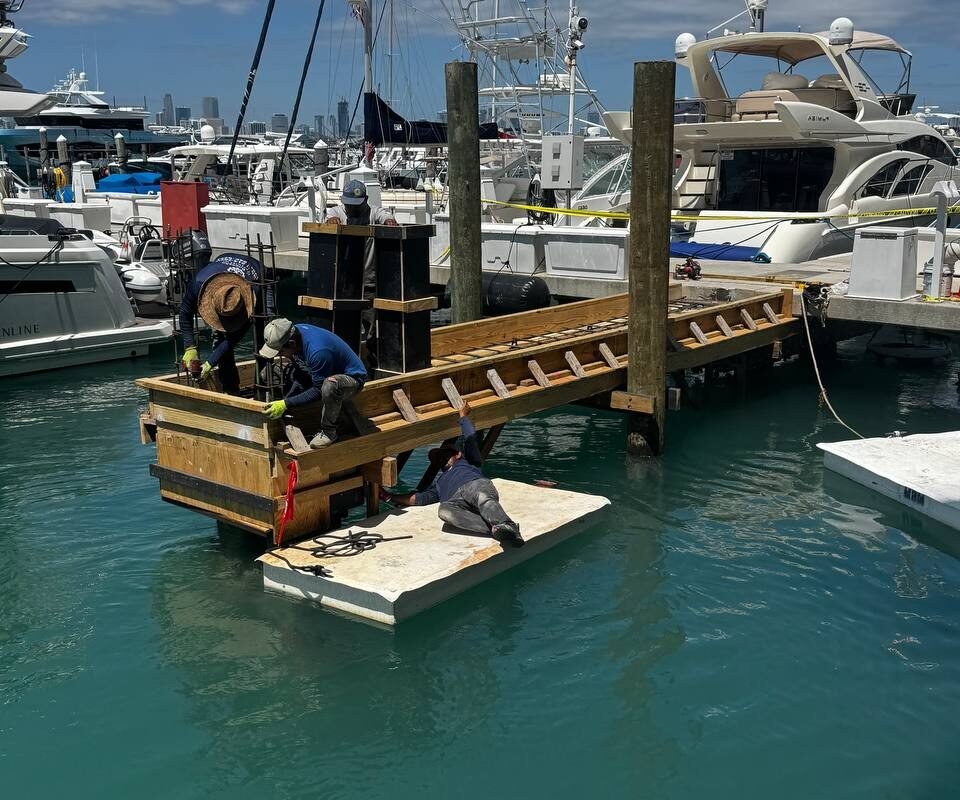
A dock piling spalling at the waterline in a Coral Gables canal doesn’t always need to come out. Sometimes a piling wrap buys another decade. Sometimes only full dock piling repair or replacement stops the failure before it takes the rest of the dock with it. The right call depends on what’s actually left of the pile below the waterline — not what you can see standing on the deck above it.
At Souffront Contractors, we get called out on dock pilings for one of three reasons: the deck is bouncing more than it used to, a piling is visibly leaning, or an insurance renewal flagged deferred maintenance. In almost every case, the owner has no idea whether they’re looking at a $400 fix or a $4,000 one. Here’s how to tell the difference before you call anyone.
Key takeaways
- The waterline zone — roughly 12 inches above and below mean high water — is where pilings fail first, on wood, concrete, and steel alike.
- A piling wrap (jacket) stops active section loss and can add 10–20 years to a pile that’s structurally sound above and below the damaged zone.
- Repair (patching, epoxy injection, splicing) works when the core of the pile is still intact and the damage is localized.
- Replacement is the answer when a pile has lost load-bearing capacity, is visibly out of plumb, or the damage extends past the waterline band.
- Most South Florida municipalities and Miami-Dade DERM require a permit for dock piling replacement, even when it’s a one-for-one swap.
What we’re actually looking at on site
On a dock inspection, we probe the pile at the waterline with a pick, check for hollow sound or soft wood, look for exposed rebar and spalled concrete on precast piles, and check steel piles for section loss and pitting. On timber, we’re also checking for marine borer activity — the tunneling that Limnoria and shipworms leave behind, usually invisible from the top of the pile and obvious once you probe below the mudline.
- Timber pilings: marine borer damage, soft or spongy wood at the waterline, splitting along the grain.
- Concrete pilings: spalling, exposed and rusting rebar, cracking that follows the reinforcement pattern.
- Steel pilings: pitting, section loss, rust bleeding down the pile — worse in brackish canal water than open bay.
What the pile looks like above the waterline tells you almost nothing. We’ve seen pilings that look fine at the cap and are down to half their original diameter three feet below the surface.
Repair: when the core is still good
Repair makes sense when the damage is localized and the pile’s core — the load-bearing center — is intact. On concrete, that usually means epoxy injection into cracks and patching spalled sections with a structural repair mortar. On timber, it can mean sistering a new member alongside a partially compromised pile to carry the load, or replacing rotted cap connections without touching the pile itself. Repair is the cheapest option and the fastest, but it’s also the one most often used past its expiration date. If the damage keeps coming back in the same spot within a year or two, the pile has moved past repair and into wrap or replace territory.
Piling wrap: buying time on a pile with active loss
A piling wrap — sometimes called a jacket or encasement — is a fiberglass or PVC form filled with a structural grout or epoxy that’s installed around the pile at and below the waterline. It stops ongoing marine borer activity, corrosion, and abrasion from continuing, and it restores some of the pile’s original cross-section. Wraps are the right call on a pile that has lost material in the waterline band but still has enough sound core to carry its share of the dock’s load. Done correctly, a wrap can add 10 to 20 years of service life to a pile that would otherwise need replacing within a couple of years. It won’t fix a pile that’s already lost structural capacity — a wrap encases what’s there, it doesn’t add strength back to a pile that’s failed.
Replacement: when nothing else stops the failure
Replace the pile when it’s out of plumb, when the damage runs the full length rather than a localized band, when you can see daylight through a timber pile, or when load testing (or simple observation) shows the pile isn’t carrying its share of the structure anymore. Full replacement means driving a new pile — timber, concrete, or steel — and transferring the dock’s load onto it before the old pile comes out, so the rest of the structure doesn’t sag or shift mid-repair. This is also where you decide whether to stay with the original material or switch. A lot of owners replacing failed timber pilings switch to precast concrete or coated steel, since both hold up longer in South Florida’s brackish canal and bay water. If you’re rebuilding more than a few pilings at once, it’s usually worth having a dock builder price the whole run rather than replacing one at a time as each fails.
What it costs and how long it takes
Piling repair and wrap work is priced per pile and driven by water depth, access, and how much material is damaged — a single wrap on an accessible canal-front pile is a very different job than a batter pile under a covered boat lift. Full replacement runs higher, since it involves driving equipment, load transfer, and often a barge if the site isn’t accessible by land. We don’t quote piling work off a phone call — every dock has different water depth, bottom conditions, and access, and those change the number more than the piling itself does. Get it scoped on site before you commit to a number, and get it in writing before any work starts.
Permits: don’t skip this on a “simple” swap
Most South Florida coastal municipalities, along with Miami-Dade DERM, require a dock permit florida review before piling replacement — even a one-for-one swap of an existing pile in the same location. Work below mean high water can also trigger a U.S. Army Corps of Engineers review depending on the waterway. Skipping the permit step is the single most common reason a dock repair turns into a compliance headache months later, usually surfacing at the worst possible time — a sale, a refinance, or an insurance renewal. New piling work in Florida’s High-Velocity Hurricane Zone also needs to meet current Florida Building Code load requirements, which is one more reason a straight swap of a 1980s timber pile with a matching timber pile isn’t always the cheapest or most compliant path.
Talk to a Florida-licensed engineer
If a piling is bouncing, leaning, or you’ve noticed a change since last hurricane season, get a dock inspection from a marine contractor who can tell you which of these three paths actually applies — before you pay for a repair that doesn’t hold. We scope the work, write the permit documents, and build it, so the same engineer who inspected the pile is accountable for how it’s fixed. The form below gets you a site visit scheduled.
Frequently asked questions
How do I know if a dock piling needs repair, a wrap, or full replacement?
It depends on how much sound material is left in the pile’s core, especially in the waterline band where damage concentrates. Localized, minor damage with a solid core usually means repair. Active material loss with a sound core left means a wrap. A pile that’s out of plumb, hollow, or damaged along its full length needs replacement. This isn’t reliably assessable from the deck — it takes probing the pile at and below the waterline.
What is a piling wrap and how long does it last?
A piling wrap is a fiberglass or PVC jacket filled with structural grout or epoxy, installed around the pile at the waterline to stop ongoing corrosion, marine borer activity, or abrasion. Done correctly on a pile with a sound core, a wrap can add 10 to 20 years of service life.
Can a wood dock piling be repaired, or does it always need to be replaced?
Timber pilings can often be repaired or wrapped if the marine borer damage or rot is localized and the core wood is still sound. Once damage runs the full length of the pile or the wood is soft and hollow at multiple points, replacement is the only option that holds.
How much does dock piling repair cost in South Florida?
Cost depends on water depth, access, pile material, and how much of the pile is damaged, so there’s no single number that applies across sites. Wraps and localized repairs are priced per pile after a site visit; full replacement runs higher due to driving equipment and load transfer. Get it scoped before assuming a cost.
Do I need a permit to replace a dock piling?
In most South Florida municipalities, yes — Miami-Dade DERM and local building departments typically require a permit for piling replacement, even a one-for-one swap in the same location. Work below mean high water can also require U.S. Army Corps of Engineers review.
How long does dock piling replacement take?
A small number of pilings can often be replaced in a few days once permits are in hand, though permitting itself can take longer than the physical work. Larger jobs involving multiple pilings, barge access, or load transfer across the whole dock structure take longer to schedule and execute.
What’s the most durable material for a replacement dock piling?
Precast concrete and coated steel pilings generally outlast timber in South Florida’s brackish canal and bay water, where marine borers and moisture cycling wear down wood fastest. The right choice also depends on your dock’s design loads and what the rest of the structure is built from.
Can I just wait and see if the piling gets worse?
Waiting is the most expensive option if the pile has active material loss, since a wrap or repair that would have worked today can turn into a full replacement in a year or two. A dock inspection gives you an actual read on how much time you have, instead of a guess.
Related from Souffront Contractors: seawall repair — all delivered by the same Florida-licensed structural engineering and marine construction team. Call (877) 420-7220.
About Souffront Contractors Inc.: a Florida-licensed structural engineering and marine construction firm serving Miami-Dade, Broward, and Palm Beach counties. Work with a Florida-licensed seawall contractor who is also the engineer of record — see our seawall contractors page or call (877) 420-7220.
Got a seawall or structural question?
Five fields. Same business day from a Florida-licensed engineer, routed into our dispatch CRM in real time.
- Same business dayAcknowledgment from a Florida licensed engineer — Mon–Fri 8 AM–5:30 PM.
- Engineer-sealed reportAccepted by carriers, building departments, and real-estate transactions.
- Fixed-fee proposalNo hourly billing. Repair scope priced line-by-line.