
How to Spot a Failing Seawall From Your Dock in 10 Min
Signs of a failing seawall you can check from your own dock in ten minutes — cracks, tilt, drainage, soil loss — and when to call a licensed engineer.
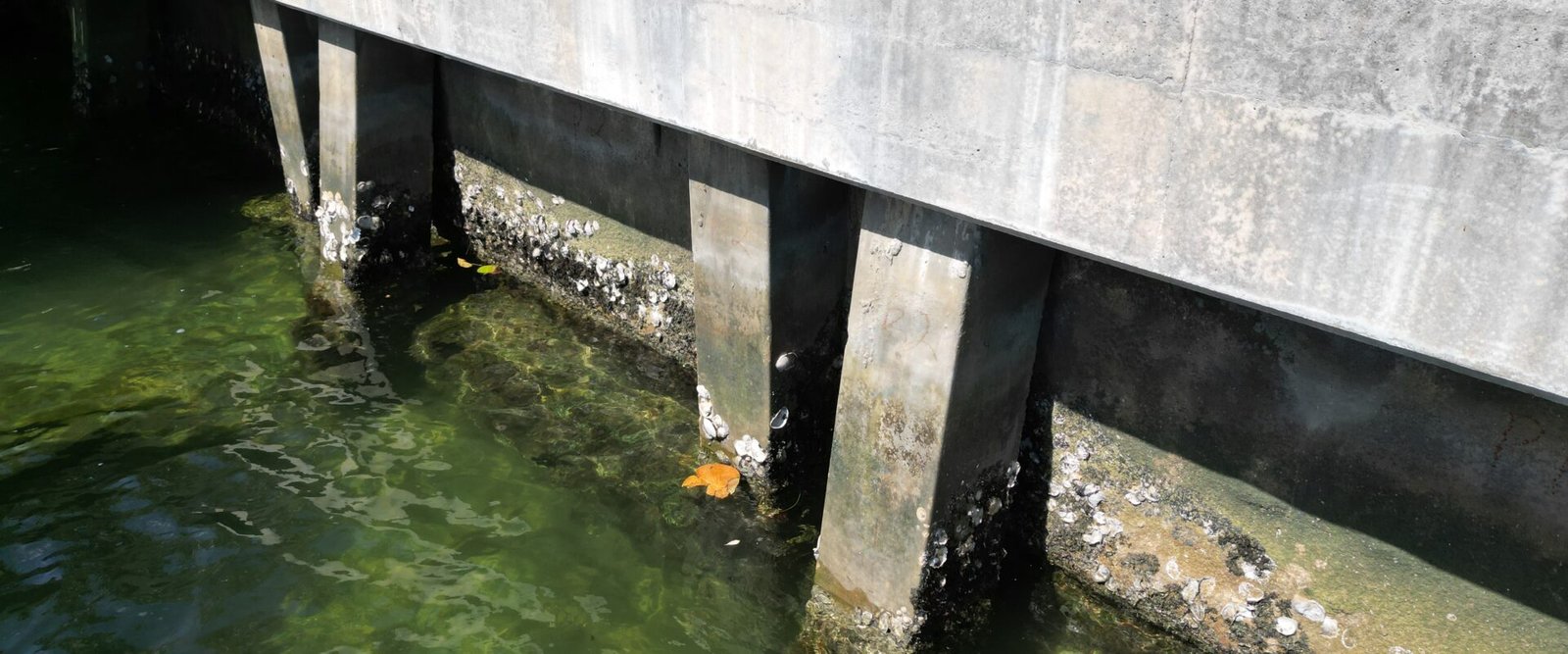
You can spot most signs of a failing seawall from your own dock in about ten minutes, without getting in the water. Walk the cap, look at the panels, check the soil behind the wall, and watch how the dock itself sits relative to the seawall. If you own waterfront property in Coconut Grove, Key Biscayne, or along Biscayne Bay, this quick check matters more than it does elsewhere — tidal swings and canal currents push on a weak wall every single day, not just during a storm.
Souffront Contractors is a Florida-licensed structural engineer that inspects, engineers, permits, and builds seawalls across Miami-Dade, Broward, and Palm Beach. This guide is what a structural engineer actually looks for on a first walk-down — the same checklist, just without the report.
Key takeaways
- You can screen for the most common seawall failure signs from your dock in about ten minutes, with no diving or special equipment.
- The four things that matter most: cracking or tilting at the cap, soil loss or sinkholes behind the wall, rust staining or spalling on panels, and a dock that no longer sits level against the seawall.
- Any sign of active soil loss or a visible lean in the wall is not a “watch it” item — schedule an inspection.
- A professional seawall inspection is a flat fee, typically $1,500–$3,000 depending on complexity, quoted before any site visit — never priced per linear foot.
- Biscayne Bay properties see more wear from tidal cycling than inland canals, so re-check these signs after any king tide or named storm.
Start at the cap — it shows problems first
The seawall cap is the concrete beam running along the top of the wall, usually the only part you can see and touch without leaning over the dock. It is also where a structural engineer looks first, because the cap telegraphs what is happening below the waterline before anything else does.
- Cracks wider than a pencil, or cracks that run the full width of the cap. Hairline cracks from concrete curing are normal. A crack you can slide a coin into is not.
- A gap between the cap and the panel below it. This usually means the panel has shifted independently of the cap — a sign the wall is no longer moving as one unit.
- Visible tilt. Kneel at one end of the dock and sight down the cap line. A wall leaning toward the water, even slightly, means something behind it has given way.
- Rust streaks bleeding through the concrete. This is corroding rebar inside the cap — the concrete is cracking from the inside out, and it gets worse, not better, on its own.
Check the panels for spalling and separation
Seawall panels are the vertical concrete sections between the cap and the mud line. From the dock, you can usually see the top two or three feet of panel above the waterline.
- Spalling — concrete flaking or breaking away in chunks, exposing the rebar underneath. This is one of the clearest signs of a failing seawall panel and it accelerates once rebar is exposed to salt water.
- Vertical cracks between panel joints that have widened noticeably since last year. Panels are engineered to move slightly at their joints — a joint that has visibly opened has shifted more than it should.
- Bulging or bowing. A panel that curves outward toward the water is under more pressure than it was built to hold, usually from soil or water buildup behind it.
Look for soil loss — the sign most owners miss
This is the one that gets skipped because it does not happen at the wall — it happens in the yard. Walk the shoreline a few feet back from the seawall, not just the cap itself.
- Depressions, dips, or small sinkholes in the lawn near the wall. Soil is escaping through a gap, crack, or failed drainage point in the wall and settling underwater on the other side.
- A visible void or dark cavity under the cap where you can see straight through to open water. This is active soil loss in progress, not a future risk.
- Sod or pavers that have sunk or cracked near the property line closest to the water. Same cause — the soil that used to be under them is gone.
Soil loss behind the wall is often connected to failed drainage — missing or clogged weep holes, or a wall with no drainage system at all — letting hydrostatic pressure build up until the wall or the ground behind it gives.
Check how your dock sits against the seawall
Your dock is a rough level, tied into your property for years, and it will show you movement the wall itself tries to hide.
- A gap that has opened between the dock and the seawall where they used to meet tightly.
- New unevenness where the dock deck used to sit flush and now has a step or slope at the seawall connection.
- Pilings that have shifted or lean near where they meet the wall — the wall may be pulling on them, or vice versa.
What these signs usually mean structurally
Most seawalls in this market are pile-supported panel walls held back by tiebacks — buried steel anchors running from the wall back into the soil — and, on many older walls, batter piles angled into the ground for added support. Cracking at the cap combined with soil loss behind the wall often points to a failed or corroded tieback no longer holding the wall against the soil pressure behind it. A panel that bulges without cracking may still have intact reinforcing but is being pushed by trapped water or soil with nowhere to drain. Only a hands-on seawall inspection that checks the wall above and below the waterline can tell you which one you are looking at — and whether it is a monitoring item or an active seawall repair need.
When to stop watching and call a structural engineer
A single hairline crack or minor rust stain is worth photographing and rechecking in six months. Any of the following mean it is time to call a seawall contractor who can also engineer the fix, not just patch what shows:
- Any visible tilt or lean in the wall, however slight.
- A crack you can fit a coin into, or one that has visibly grown since you last checked.
- Any sinkhole, depression, or void behind the wall — this is active, ongoing soil loss.
- Spalling with exposed rebar on more than one panel.
- A dock that has pulled away from, or dropped relative to, the seawall.
A full structural inspection — above the waterline and, where warranted, a below-waterline dive — is a flat fee, typically $1,500 to $3,000 depending on the complexity of the inspection, quoted upfront before anyone steps on your dock. It is never priced by linear foot; that pricing only applies to repair or replacement work. Property owners near Coconut Grove, Coral Gables, and Key Biscayne should factor in that tidal cycling on Biscayne Bay tends to accelerate whatever a wall is already showing, so a “watch it” crack there is worth rechecking sooner than the same crack on a still canal.
Talk to a Florida-licensed engineer
If your ten-minute check turned up any of the warning signs above, the next step is a full inspection, not a guess. Souffront provides an engineer-sealed report at a fixed fee quoted before the visit, with a same-business-day response when you reach out. The contact form below goes straight to our team.
Frequently asked questions
What are the first signs of a failing seawall?
The earliest visible signs are cracking or tilting at the cap, spalling concrete with exposed rebar on the panels, and soil depressions or sinkholes in the yard behind the wall. Rust staining bleeding through the concrete is also an early warning, since it means the rebar inside is already corroding.
Can I check my seawall myself, or do I need a diver?
You can screen for most major warning signs from your dock in about ten minutes — cap condition, panel cracking, soil loss, and dock alignment do not require getting in the water. A below-waterline check is only needed once a surface check raises a concern, or as part of a full engineer inspection.
How much does a seawall inspection cost?
A professional seawall inspection is a flat fee, typically $1,500 to $3,000 depending on the complexity of the inspection, quoted before any site visit. It is priced by scope and access, not by the length of the wall — per-linear-foot pricing applies only to repair or construction work.
How often should I check my seawall for damage?
Walk the cap, panels, and shoreline behind the wall at least twice a year, and again after any named storm or significant king tide event. Biscayne Bay and other tidally active waterfront properties should check more often, since daily tidal cycling accelerates existing cracks and joint separation.
What causes soil loss behind a seawall?
Soil loss usually happens through a crack, gap, or failed drainage point in the wall, where fine soil particles wash through into the water on the other side over time. It is frequently linked to a failed tieback or a wall with clogged or missing weep holes, which lets hydrostatic pressure and soil movement build up unchecked.
Is a bulging seawall panel an emergency?
A bulging panel means the wall is under more pressure than it was built to hold, and it should be inspected promptly rather than monitored. It is not always an immediate collapse risk, but it will not resolve on its own and typically worsens with the next heavy rain or storm surge.
Do I need a permit to repair my seawall?
Yes — seawall repair in Miami-Dade and Broward typically requires permitting through the local building department and, depending on scope, Miami-Dade DERM environmental review. An engineer who inspects, designs, and handles permitting in-house can move a repair through this process faster than coordinating separate firms for each step.
What is the difference between a seawall inspection and a seawall repair estimate?
A seawall inspection is an engineering assessment of the wall’s current condition, documented in a sealed report with findings and recommendations. A repair estimate is priced work to fix specific problems the inspection identifies — you need the inspection first to know what, if anything, actually needs repair.
Related from Souffront Contractors: dock repair and engineer-sealed reports — all delivered by the same Florida-licensed structural engineering and marine construction team. Call (877) 420-7220.
About Souffront Contractors Inc.: a Florida-licensed structural engineering and marine construction firm serving Miami-Dade, Broward, and Palm Beach counties. Explore our seawall construction and marine construction capabilities — see our seawall contractors page or call (877) 420-7220.
Got a seawall or structural question?
Five fields. Same business day from a Florida-licensed engineer, routed into our dispatch CRM in real time.
- Same business dayAcknowledgment from a Florida licensed engineer — Mon–Fri 8 AM–5:30 PM.
- Engineer-sealed reportAccepted by carriers, building departments, and real-estate transactions.
- Fixed-fee proposalNo hourly billing. Repair scope priced line-by-line.